
Best accounting software in Germany for freelancers and small businesses: compliance, price, and simplicity
If you’re searching for the best accounting software Germany offers as a freelancer or small business, this guide is your starting point. You’ve registered your business, opened a bank account, and felt genuinely proud of yourself. Then the first tax quarter arrives. Your invoicing app, the one you used perfectly well back home, can’t file a VAT return via ELSTER. It doesn’t know what an EÜR is. And your new client just asked for an XRechnung. Suddenly, “I’ll just use the same tool as before” stops being an option.
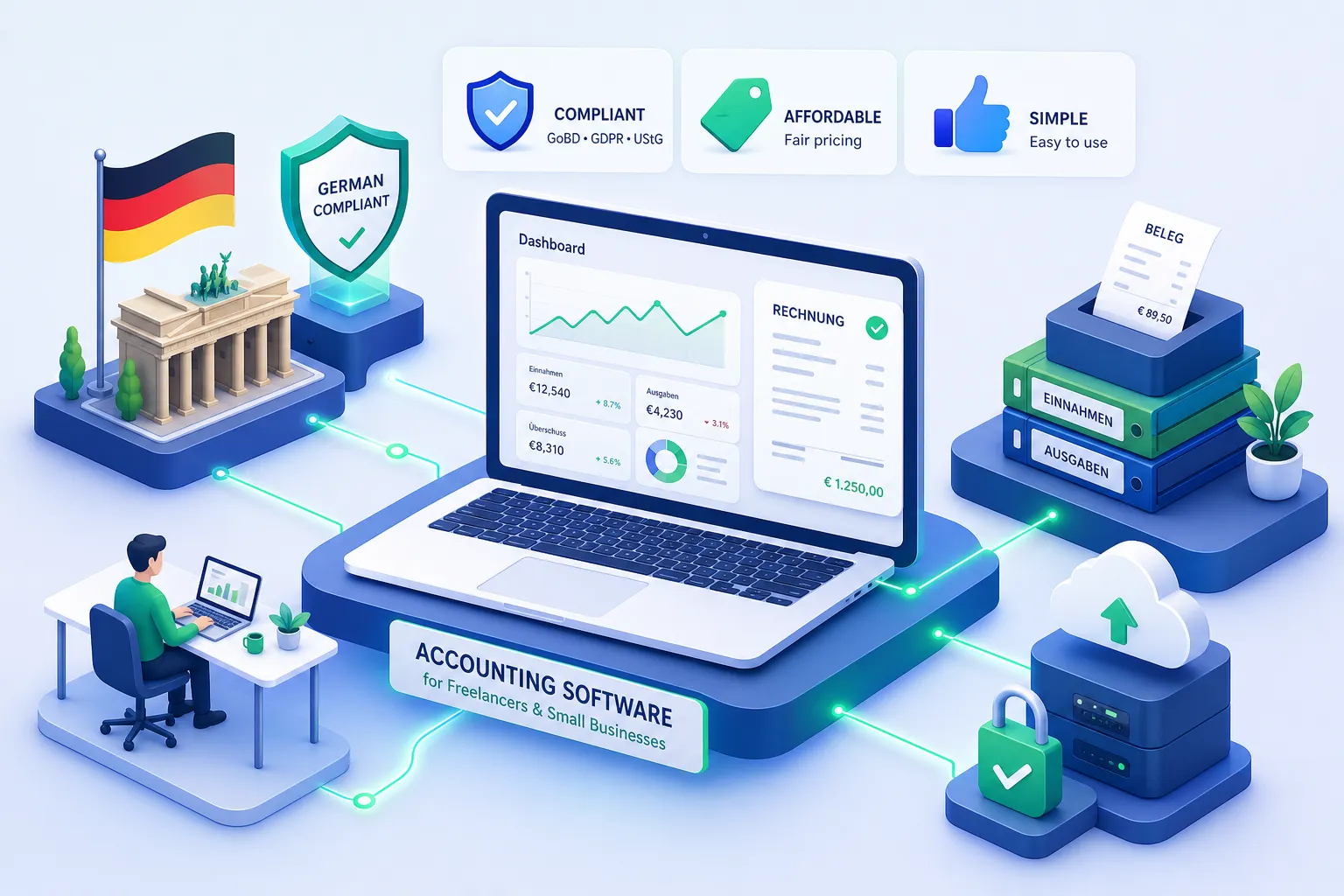
This is exactly the situation that tools like Kontelio are built for: cloud accounting software designed specifically for Germany’s compliance environment, not bolted on as an afterthought. Choosing the right accounting software for your German business isn’t just a matter of picking whatever is cheapest or most popular internationally. German tax law creates a specific set of obligations that most generic tools simply don’t handle natively, and getting it wrong costs more than the subscription ever would.
This guide is for freelancers, sole traders, and small business owners who want to manage their books legally and efficiently without relying on a Steuerberater for every submission. We’ll cover what makes German accounting compliance different, what features to look for, how the main tools compare, and how to match the right software to your specific situation.
Why accounting in Germany is a different problem entirely
Most countries have basic bookkeeping requirements: track income, track expenses, file a return. Germany has that too, but layers on additional obligations that catch a lot of business owners off guard, especially those who relocate here or start freelancing without a formal accounting background.
The compliance stack: ELSTER, EÜR, and GoBD explained
Germany requires freelancers and sole traders to submit tax declarations electronically via ELSTER, the official government portal operated by the German tax authorities. This isn’t optional, and emailing a PDF to your local Finanzamt doesn’t count. Alongside this, most freelancers and sole traders must generate an EÜR (Einnahmenüberschussrechnung), the income surplus calculation used in place of a full double-entry profit and loss statement. It’s a simplified method, but it still needs to be filed correctly and on time.
Then there’s GoBD, the German principles for properly maintaining and storing books and records. Under GoBD, receipts and tax-relevant documents must be archived in a tamper-proof format, with an audit trail proving the records haven’t been altered. Retention periods vary by document type: books and annual accounts must be kept for ten years, while invoices and booking vouchers are subject to an eight-year retention period following 2024 rule changes, and business correspondence requires six years. Receipts stored in a regular cloud folder don’t qualify. Many tools from outside Germany won’t handle these requirements natively, and discovering that mid-quarter is an unpleasant surprise.
The 2025 e-invoicing mandate and what it means for your invoices right now
Since January 2025, every business operating in Germany, including freelancers and those using the small-business scheme under §19 UStG, must be able to receive structured e-invoices. That means your accounting setup needs to handle XRechnung and ZUGFeRD formats, not just PDFs. XRechnung is a pure XML format used primarily for public-sector billing. ZUGFeRD is a hybrid: a readable PDF with embedded structured XML data, which makes it more common in B2B transactions where the human-readable version still matters.
Mandatory issuing of e-invoices begins in 2027 for businesses with prior-year turnover above €800,000, and extends to everyone else in 2028. That timeline might feel distant, but setting up the right software now means you’re ready before the deadline, not scrambling at it. Any business accepting payment from a German client should already be thinking about this.
Five features that separate compliant German accounting software from the rest
Before comparing specific products, it helps to understand what the compliance requirements actually demand from your software. These aren’t bonus features; they’re the baseline for operating legally in Germany.
ELSTER integration and GoBD-compliant document archiving
Native ELSTER integration means the software connects directly via an ELSTER certificate, lets you review your VAT return or EÜR, and submits it straight to the Finanzamt without any manual export or portal-switching. Some tools generate a PDF that you’re then expected to upload to ELSTER yourself. That’s not integration; that’s half the job done. True integration handles the authentication, transmission, and confirmation receipt within a single workflow.
GoBD-compliant archiving is equally non-negotiable. Documents must be stored in a format that prevents tampering, with audit logs showing what was stored, when, and by whom. Not every “upload your receipts” function meets this standard. Look for software that explicitly states GoBD compliance, stores files in their original format, and retains them for the full statutory period.
XRechnung, ZUGFeRD, and legally compliant invoice creation
Compliant invoice creation in Germany requires more than a nice-looking PDF. Every invoice must include your tax number or VAT ID, the date, a description of the service, a sequential invoice number, and the correct VAT rate applied automatically. Export needs to be available in structured XML or hybrid PDF format to meet the e-invoicing requirements. A DATEV-compatible export is also worth having if you work with a tax advisor, since it allows clean data handoff without manual rekeying.
A tool that handles all of this from a single screen saves hours each month and eliminates the kind of errors that trigger queries from the Finanzamt. Getting an invoice returned because a mandatory field is missing is a minor inconvenience the first time, and a costly pattern if it repeats.
Multilingual interfaces: a critical feature for Germany’s international workforce
A large and growing number of self-employed immigrants and international professionals run legally registered businesses in Germany. Many read German well enough for daily life but find navigating accounting software in a second language introduces real error risk. An interface in your native language, whether that’s English, Turkish, Arabic, or Polish, significantly reduces that risk. This feature is often overlooked in comparisons that assume all users are native German speakers.
The best accounting software in Germany right now: a focused comparison
The table below gives a quick snapshot of compliance features and pricing across the main options discussed in this guide.
| Tool | ELSTER filing | EÜR | XRechnung | ZUGFeRD | DATEV export | Multilingual | Starting price |
|---|---|---|---|---|---|---|---|
| Kontelio | Yes (direct, from the Business plan) | Yes | Yes | Yes | No (free tax-advisor access instead) | Yes (9 languages) | €9.90/month (ELSTER from €22.90/month) |
| Accountable | Yes (direct) | Yes | Yes | See provider | See provider | German, English | €9.90/month |
| Lexware Office | Yes (direct) | Yes | Yes | See provider | Yes | Not documented | €7.90/month |
| sevDesk | Yes (direct) | Yes | Yes | See provider | Yes | German, English | €9.90/month |
Kontelio: the cloud accounting tool built for freelancers and non-accountants
Kontelio brings invoices, expenses, receipts, EÜR, VAT returns, and ELSTER submission into one unified dashboard, without the complexity of traditional accounting software. The interface adapts to your business type: in the simplified mode, functions you don’t need stay one click away in the full view rather than cluttering your screen. This design choice is deliberate, and it makes a real difference for anyone who isn’t an accountant by training.
To make this concrete: imagine a freelance translator based in Berlin whose working language is Turkish. Using Kontelio in Turkish, she creates ZUGFeRD invoices for her German clients, photographs receipts with her phone for GoBD-compliant archiving, and, with the Business plan, submits her quarterly VAT return via ELSTER. All of this happens without switching apps or calling her tax advisor. Her Steuerberater has direct access to her data when needed, making year-end reconciliation straightforward. That’s the practical value of having the full compliance stack in one product.
According to Kontelio’s product documentation, the platform supports nine languages, integrates ELSTER certificate-based submission directly, and handles both ZUGFeRD and XRechnung creation and receipt. Data is stored in compliance with GDPR, and the platform generates the EÜR automatically from recorded transactions. For freelancers handling their own books, this means the full compliance stack in a single product.
Lexware Office and sevDesk: the established alternatives
Both Lexware Office and sevDesk are popular, well-reviewed tools in the German market. Lexware Office scores 4.4/5 on Capterra (as of 2026) and starts from €7.90/month (as of September 2026, net) with a 30-day trial. According to the provider, sevDesk holds ISO/IEC 27001 certification; it scores 3.9/5 on Trustpilot across nearly 3,000 reviews (as of 2026) and supports XRechnung. Both offer DATEV export capabilities, making them solid choices for businesses working with a Steuerberater.
According to the providers, both tools transmit the advance VAT return (UStVA) to ELSTER themselves; check with each provider which further returns, such as the Anlage EÜR, can be filed directly from the product and in which plan. According to sevDesk, its interface can also be switched to English; we found no information from Lexware about interface languages other than German. Verify the current feature set directly with each vendor. If you’re comfortable in German and have a tax advisor managing your filings, both are reliable choices. If you’re handling submissions yourself or working primarily in another language, check these points carefully before you decide.
Accountable: a freelancer-focused option with strong tax features
Accountable earns a Trustpilot score of 4.8/5 (as of 2026) and covers a strong compliance stack: XRechnung, VAT submission, and EÜR filing via ELSTER. Its interface is clean and designed for freelancers rather than adapted from small-business accounting software.
The constraints are worth noting. According to the provider, Accountable is available in German and English; we found no information about further interface languages, which limits its usefulness for international freelancers who prefer another language. Its plans cost €9.90 to €59.90/month (as of September 2026, net); check with the provider which plan includes the tax filing features you need. It’s a strong option for German- or English-speaking freelancers who want direct ELSTER filing and don’t require further languages.
Pricing for the best accounting software in Germany: what you actually get at each tier
Entry-level options: free plans, trials, and sub-€10 tiers
At the lower end, sevDesk starts at €9.90/month and Lexware Office at €7.90/month with a 30-day trial (both as of September 2026, net). FastBill enters at approx. €9/month with a 14-day trial (as of 2026, check with the provider). Many entry-level plans cap the number of invoices or exclude ELSTER and EÜR functionality; a plan that looks inexpensive but requires separate tax submission software rarely ends up being the lowest total cost.
Mid-range plans: where full compliance features unlock
The €15 to €30/month range is where many tools activate their full compliance stack. sevDesk’s plans run from €9.90 to €30.90/month, Accountable’s from €9.90 to €59.90/month (both as of September 2026, net). Zoho Books has a free tier, but paid plans in Germany start around €30/month (approx., as of 2026, check with the provider). Kontelio consolidates invoicing, EÜR, ELSTER submission, and e-invoicing into its Business plan (€22.90/month or €199/year, net) without requiring add-ons or a separate tax-filing tool, which makes the comparison more straightforward than the headline prices suggest.
Choosing the right tool for your situation
Freelancer or sole trader handling everything yourself
If you’re a freelancer or Einzelunternehmer without a tax advisor, your software needs to cover the full stack: EÜR and VAT returns filed directly via ELSTER, legally compliant invoices with ZUGFeRD and XRechnung support, and GoBD-compliant document archiving. If you’re not working primarily in German, multilingual support moves from “nice to have” to essential. Kontelio covers all of these requirements in one product and is the clearest fit for this profile. Accountable is a strong alternative if you’re confident in German or English and don’t need further interface languages.
Small business or team working with a Steuerberater
If your tax advisor handles ELSTER filings, the priority shifts to clean DATEV export, reliable receipt management, and smooth data handoff. Lexware Office and sevDesk are well-suited here, with established DATEV export workflows and solid feature sets for team use. Both offer free trials, 30 days for Lexware Office and 14 days for sevDesk (as of 2026), so testing before committing is straightforward.
The best accounting software Germany has to offer isn’t the one with the most features or the lowest price, it’s the one that handles your specific compliance obligations without requiring extra tools or a tax advisor for every submission. If Kontelio matches your filing needs, your language, and the way you actually work, you can explore it directly before making any commitment.
More about the matching Kontelio feature: Self-employed
Step by step in the Kontelio user manual: Software comparison
As of: October 2026. General information, not tax advice.