
Is FreshBooks right for freelancers in Germany? Feature and compliance comparison with a local alternative
You find FreshBooks through an English-language freelancer blog, the pricing looks reasonable, the interface looks clean, and you sign up. Then reality sets in. A German client asks for a ZUGFeRD invoice. Your Steuerberater wants a DATEV-compatible export. Your Finanzamt expects your Umsatzsteuervoranmeldung filed through ELSTER. Suddenly, a globally popular invoicing tool starts to feel like a tool built for a different country entirely, because it is. If you have been researching FreshBooks Germany options, you are not alone, and the gap between what FreshBooks offers and what German compliance requires is worth understanding before you commit.
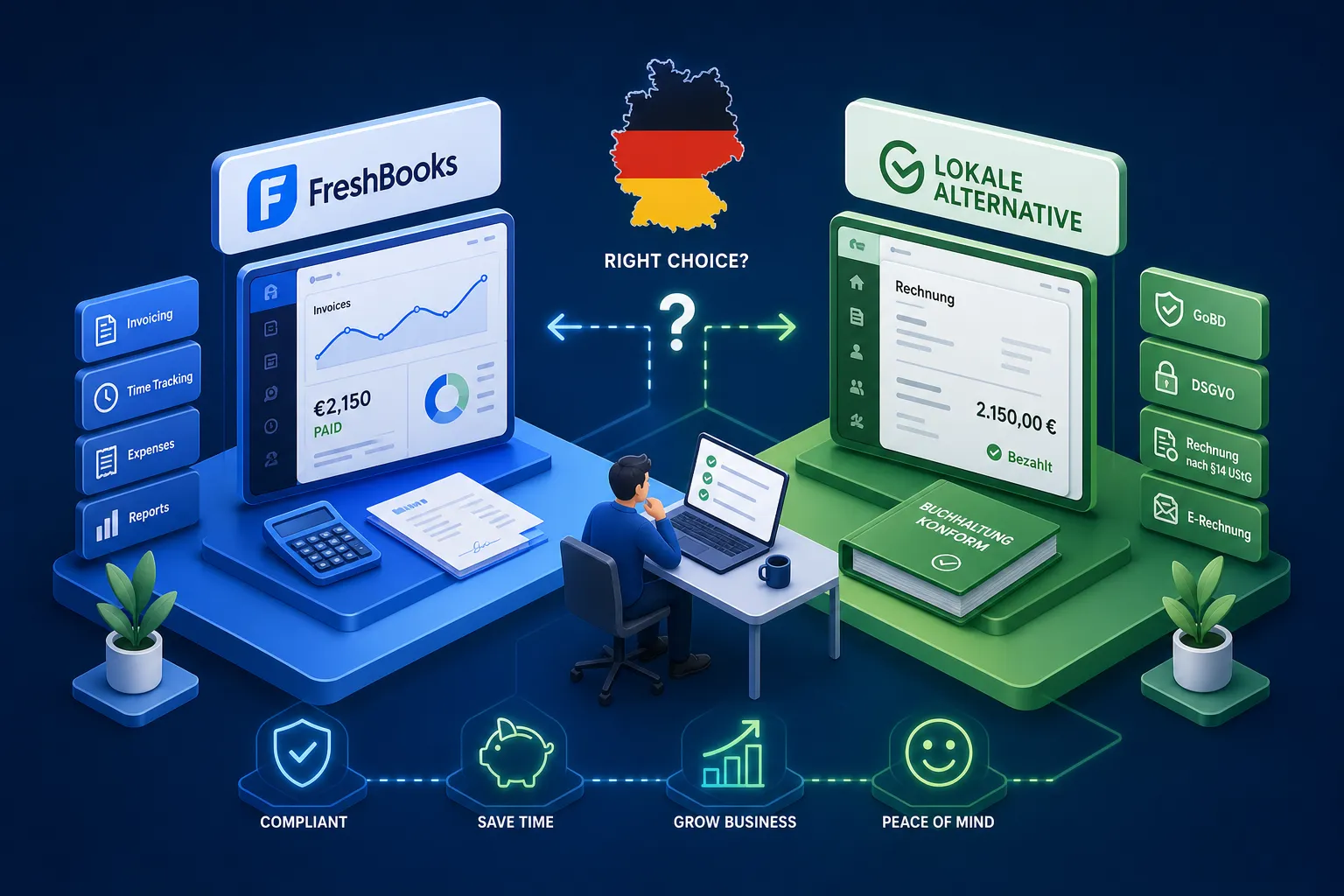
This article gives you a straight answer on whether FreshBooks works for freelancers and small businesses in Germany. It covers what the German compliance baseline actually looks like, where FreshBooks holds up, where it creates real risk, and what a purpose-built local alternative like Kontelio offers instead. No vague praise, no hit-piece. Just the information you need to make a confident decision.
German accounting law has specific obligations that most international software does not address: ELSTER submissions for VAT returns and annual filings, EÜR reporting as the standard profit calculation method for freelancers, GoBD-compliant archiving with a 10-year retention requirement, and the staged rollout of mandatory B2B e-invoicing in ZUGFeRD and XRechnung formats. Evaluating any accounting tool for use in Germany means checking it against these standards, not just asking whether it can produce a PDF with a euro symbol.
What German freelancers actually need from bookkeeping software
Before judging any tool, it helps to be clear about what “German-compliant” means in concrete terms. Most freelancers and self-employed individuals in Germany (Selbstständige and Freiberufler) must submit an Einnahmenüberschussrechnung (EÜR) as their annual profit and loss statement. That filing goes through ELSTER, the German tax authority’s electronic submission portal. Accounting software that cannot connect to ELSTER adds a manual step every time you file, which introduces both friction and error risk.
GoBD sets the rules for how records are kept and archived: completeness, traceability, protection against later alteration, and a 10-year retention period for tax-relevant documents. Any cloud software used for German bookkeeping should document GoBD conformity, covering not just security but the full archiving process, including audit trails, correction logs, and machine-readable exports. A general GDPR compliance statement does not cover these specific requirements.
Germany’s B2B e-invoicing mandate adds another layer. Since January 2025, every German business must be able to receive structured electronic invoices in EN 16931 format, which means ZUGFeRD or XRechnung in practice. From 2027, businesses with 2026 turnover above €800,000 must also issue compliant e-invoices. From 2028, the issuance obligation extends to all businesses regardless of size. A tool that cannot produce or receive these formats is already behind the curve for any freelancer working in domestic B2B.
FreshBooks Germany: what it handles and where it stops
FreshBooks deserves fair credit for what it does handle. According to its product documentation, it supports EUR as a base currency, allows German as the invoice language, and provides fields for tax numbers and VAT identification numbers. Invoice numbering is sequential and configurable. For a freelancer issuing straightforward service invoices to German clients, this covers the surface-level basics. That said, your final template and numbering sequence should still be reviewed by a Steuerberater to confirm it includes all Pflichtangaben under §14 UStG: the full name and address of both parties, the date of supply, the sequential invoice number, a clear description of services, the net amount, the applicable VAT rate, and the VAT amount shown separately.
VAT handling is workable but manual. FreshBooks lets you create custom tax rates, so 19% and 7% German VAT can be added. Freelancers under the Kleinunternehmerregelung (§19 UStG) can omit VAT and add the required exemption note by hand. In 2026, the Kleinunternehmer thresholds are €25,000 for 2025 turnover and €100,000 as the hard current-year ceiling, so monitoring those figures throughout the year matters. Reverse charge invoices can be configured by setting a 0% rate and adding the required German wording (“Steuerschuldnerschaft des Leistungsempfängers”).
These configurations work. But they require you to know exactly which rule applies to each transaction, because we found no information from FreshBooks (as of October 2026) that the software guides you through German tax rules. For freelancers who are still finding their feet with German tax rules, that is a meaningful gap.
The compliance gaps that matter for FreshBooks in Germany
This is where the picture changes. According to FreshBooks’ published information (as of October 2026), FreshBooks does not generate structured e-invoice files in ZUGFeRD or XRechnung format. For any German freelancer doing domestic B2B work, this is not a minor inconvenience. The obligation to receive these formats is already active, and the obligation to send them is on a fixed timeline. A tool that cannot produce compliant structured invoices forces you to maintain a separate conversion service or manual process alongside your main software, which defeats much of the purpose of using accounting software at all.
According to FreshBooks’ published information (as of October 2026), there is also no ELSTER integration. That means VAT advance returns (Umsatzsteuervoranmeldung) and the EÜR cannot be submitted directly from FreshBooks. You export data, prepare figures separately, and file through a different system or through your accountant. Every extra manual step between your bookkeeping records and your tax filing is a place where discrepancies can appear. For freelancers managing their own filings, this significantly increases the workload at every reporting deadline.
FreshBooks does not document GoBD-compliant archiving (as of October 2026). According to FreshBooks’ published information, its standard exports are not in DATEV format, which means a Steuerberater who works with DATEV will need to reformat or re-enter data, adding time and cost to every collaboration. According to FreshBooks, bank feeds for German institutions rely on third-party aggregators such as Plaid and Yodlee, and we found no published compatibility list for specific German banks.
Two further issues are worth flagging separately. EBICS, the protocol used by most German corporate banking systems, is not natively supported by FreshBooks, according to FreshBooks’ published information (as of October 2026). And on data residency: according to its privacy policy, FreshBooks may store data in the United States, with transfers governed by Standard Contractual Clauses rather than guaranteed EU-only storage. For any freelancer handling client data subject to strict data-protection obligations, that distinction is worth checking with a legal adviser.
Kontelio: the German-built alternative that covers the gaps
Kontelio is not positioned here as a competitor to FreshBooks. It is the logical conclusion of the analysis above: a tool designed from the start for the German requirements that, according to FreshBooks’ published information, FreshBooks does not cover. It was built for German freelancers, in Germany, with German compliance obligations as the starting point rather than an afterthought.
ELSTER submission is built in, not bolted on. In the Business and Pro plans, Kontelio validates your returns with ERiC and sends them directly to ELSTER with your ELSTER certificate, so advance VAT returns, the annual VAT return and the Anlage EÜR go out from the same interface where you record your income and expenses. The Anlage EÜR with AVEÜR is prepared from your bookkeeping records, no manual export, no reformatting, no second system. According to Kontelio’s product documentation, ZUGFeRD (EN 16931) and XRechnung are supported natively from the Start plan, so freelancers already affected by the e-invoicing requirements can create and receive compliant structured invoices without switching tools or using a separate conversion service.
Receipts and documents can be uploaded, photographed, and archived unalterably in a way that Kontelio describes as GoBD-compliant, covering the required 10-year retention period. That removes a real liability that users carry when relying on general cloud storage or personal folders for document archiving. Kontelio is also available in nine languages: German, English, Portuguese, Spanish, Italian, Turkish, Arabic, Polish and French, with the official German tax terms kept visible. For freelancers who have relocated to Germany and need to understand German accounting obligations in their native language, that is a genuine practical advantage. After onboarding, a simplified mode shows only the functions relevant to your business profile, and you can switch to the full view at any time.
Steuerberater collaboration is also straightforward. From the Business plan, your accountant gets free access with their own role to review your data and export the reports they need. For users who currently hand off export files to their accountant, this can significantly reduce the reformatting work on both sides. Kontelio does not offer a DATEV export, so check beforehand whether this shared access matches your Steuerberater’s setup; if it does, the handoff becomes a shared workspace rather than a file exchange with manual cleanup.
Making the move: migration steps and a compliance checklist
If you are currently using FreshBooks and want to migrate, the process is manageable. Export all invoices, expense records, and client data from FreshBooks in CSV or PDF format before closing the account, FreshBooks’ help documentation covers which formats are available for each data type. Set up your new account in Kontelio and configure the correct VAT rates, invoice numbering sequence, and company details from scratch rather than importing from a previous system. Recreate your client records, enter open items as of your cut-off date, and archive the FreshBooks export files as part of your own retention records for the statutory period.
Before going live with any new bookkeeping setup, run through this checklist to confirm your German compliance baseline is in place:
- German VAT rates (19% / 7%) configured correctly in your invoice templates
- Kleinunternehmerregelung note added if applicable, with a clear §19 UStG reference
- Invoice template includes all Pflichtangaben: tax number or VAT ID, sequential invoice number, date of supply, and payment terms
- ELSTER certificate connected for direct VAT and EÜR submissions (in Kontelio from the Business plan)
- ZUGFeRD or XRechnung output enabled for domestic B2B clients
- GoBD-compliant document archiving active for receipts and incoming invoices
- Steuerberater access granted if you work with an accountant
The verdict on FreshBooks Germany: a practical decision, not a close call
FreshBooks can serve a German freelancer for basic EUR invoicing and manually configured VAT setups. For a very simple operation issuing a handful of invoices per month to non-German clients, it may be sufficient for now. But according to its published information (as of October 2026), it is not a German compliance solution. Without documented support for ZUGFeRD and XRechnung, ELSTER integration, GoBD archiving, or a DATEV export, it adds manual work at every stage and carries real compliance risk as Germany’s e-invoicing mandates move from receiving requirements to sending requirements over the next two years.
For freelancers in Germany who want a tool that handles the full compliance stack without workarounds, Kontelio covers ELSTER, EÜR, ZUGFeRD and XRechnung, GoBD-compliant archiving, and multilingual access in a single interface (ELSTER filing and the EÜR from the Business plan). Those are not bonus features. They are the core requirements of running a legal bookkeeping operation in Germany.
If this article helped you reach a decision, the next step is straightforward: try Kontelio free for 30 days and walk through the German-specific features yourself, or reach out to the Kontelio team to see how the compliance setup works in practice for your type of business. The tool was built for exactly this situation.
More about the matching Kontelio feature: Self-employed
Step by step in the Kontelio user manual: FreshBooks in Germany
As of: October 2026. General information, not tax advice.