
Input VAT Deduction: Requirements and Correct Timing 2026

You may reclaim the Umsatzsteuer (VAT) on an incoming invoice from the Finanzamt (local tax office) if four conditions are met at the same time: you are a VAT-liable business owner, the service was provided for your business, you have a proper invoice with the tax shown separately, and the expense is not connected with VAT-exempt sales. If any one of these is missing, the Vorsteuer (input VAT) remains a cost factor. Here you can read what each requirement means in everyday practice, in which month you claim the input VAT and where self-employed people most often leave money on the table.
In brief
- The Vorsteuerabzug (input VAT deduction) is governed by § 15 UStG. Kleinunternehmer (small businesses under the small-business VAT scheme) pursuant to § 19 UStG are excluded from it.
- The invoice must contain all mandatory details; otherwise you cannot exercise the deduction, even if the service was genuine.
- Whether you have already paid the invoice does not matter. Exception: advance payments, where you need the invoice and the payment.
- The tax administration grants the deduction in the advance return period in which both the service and the invoice are present. An EU court ruling of 11 February 2026 calls this into question.
- Anyone who makes VAT-exempt sales, such as medical treatments or residential letting, loses the deduction for the related costs entirely or in part.
Table of contents
- What the input VAT deduction is and why it is not a bonus
- The requirements at a glance
- The four requirements in detail
- The right time for the input VAT deduction
- Input VAT without a classic invoice: three special cases
- How to secure your input VAT deduction in practice
- Our view on the input VAT deduction
- Recording input VAT properly with Kontelio
- Frequently asked questions about the input VAT deduction
- Sources
What the input VAT deduction is and why it is not a bonus
Input VAT is the VAT that other businesses charge you for supplies of goods and services. The Finanzamt NRW describes it as a pass-through item: economically, VAT is borne by the end consumer, not by your business.
In practice, this means: you deduct the input VAT you have paid from the VAT you charge your customers and transfer only the difference. If the input VAT is higher in a given month, for example because you have just made an investment, the Finanzamt refunds the surplus.
An example: you buy a laptop for €1,000 net plus €190 VAT. In the same month, you issue invoices for €5,000 net plus €950 VAT. Your UStVA (periodic advance VAT return) then shows €950 VAT minus €190 input VAT, and you pay €760. So the laptop effectively costs your business €1,000, not €1,190. We explain in detail how tax rates and the advance return work together in our guide to VAT for the self-employed.
This is precisely why founders should not see the input VAT deduction as a tax gift. It merely ensures that VAT remains neutral at every stage of the supply chain. Anyone who loses it ends up paying extra.
The requirements at a glance
Before we go into detail, here is the overview. The specialist literature distinguishes between the substantive requirements (was a service really obtained for the business?) and the formal requirement (is there a correct invoice?). The advisory firm BDO also emphasises this distinction in its analysis of current case law.
| Requirement | What is checked | Typical pitfall |
|---|---|---|
| Business owner status | You are an Unternehmer (business owner) and not a Kleinunternehmer | Kleinunternehmerregelung (small-business VAT scheme) chosen |
| Service for your business | Another business owner has supplied goods or services to you, specifically for your business | Items with mixed use, private share |
| Proper invoice | Mandatory details under §§ 14, 14a UStG, tax shown separately | Vague description of the service, wrong address |
| No exclusion | The expense does not serve VAT-exempt sales | Letting, healthcare professions, insurance brokerage |
The four requirements in detail
1. You are a business owner under Regelbesteuerung
Only someone who is a business owner within the meaning of VAT law may deduct. This applies to Freiberufler (independent professionals) just as much as to traders; the distinction plays no role here (more on this under Freiberufler or Gewerbe).
The most important exception is Kleinunternehmer. According to the Finanzamt NRW on the Kleinunternehmerregelung, the scheme applies if turnover in the previous year did not exceed €25,000 and is not expected to exceed €100,000 in the current year. Anyone who uses it does not show VAT on invoices and, in return, may not deduct input VAT.
That sounds convenient, but it can become expensive. If you are planning a larger purchase, such as machinery, a vehicle or a complete office fit-out for €12,000 net, the roughly €2,280 in VAT stays with you as a Kleinunternehmer. Running costs such as rent for business premises, software subscriptions and energy also become costs at their gross amount. Anyone who works out the electricity costs in a small business will quickly see that VAT is paid along with every instalment. Whether switching to Regelbesteuerung (standard VAT taxation) pays off depends mainly on whether your customers are business owners who can deduct input VAT themselves. We have broken down this trade-off in our guide to the Kleinunternehmerregelung 2026. Because the switch can have consequences for several years, talk to your tax advisor before making it.
2. The service was performed for your business
§ 15 Abs. 1 UStG requires that another business owner has performed the supply of goods or other service for your business. This excludes two groups: purchases from private individuals (who do not owe VAT) and purchases for your private life.
Three points from the law that self-employed people should know:
- The 10 percent threshold: If you use an item less than 10 percent for your business, it is not considered acquired for the business. No input VAT deduction, not even partially.
- Non-deductible business expenses: Under § 15 Abs. 1a UStG, input VAT is excluded for expenses that fall under the deduction ban of § 4 Abs. 5 EStG for income tax purposes, such as overly expensive gifts to business partners. The law expressly exempts Bewirtungskosten (business entertainment expenses); here the input VAT deduction remains possible for reasonable, documented expenses. Which costs count as Betriebsausgaben (deductible business expenses) in the first place is shown in our list on deducting business expenses.
- Mixed use: For a car that you also drive privately, the deduction is initially possible; the private use is then taxed as a withdrawal. How the 1% rule and the logbook work here is explained under private use of a company car.
The most common misconception: input VAT is a mere formality as soon as an invoice is made out in the company's name. That is not true. Without actual business use there is no deduction, no matter how clean the document looks.
3. You have a proper invoice
This is where most deductions fail in a Betriebsprüfung (tax audit). The tax must be shown separately in an invoice pursuant to §§ 14, 14a UStG, as stated in the Umsatzsteuer-Anwendungserlass (VAT Application Decree), section 15.2a. The mandatory invoice details at a glance:
- Full name and address of the supplying business owner and of your business
- Steuernummer (tax number) or USt-IdNr. (intra-EU VAT identification number) of the supplier
- Date of issue
- Sequential invoice number, assigned only once
- Quantity and customary trade description of the goods, or type and scope of the service
- Date of the supply or service
- Consideration, broken down by tax rate, as well as any reductions agreed in advance
- Tax rate and tax amount, or a note on a tax exemption
How strictly this is applied is shown by a decision of the Bundesfinanzhof (Federal Fiscal Court): with an invoice without a sufficient description of the service, a right to input VAT deduction that may exist cannot be exercised. So “consulting services as agreed” is not enough. Check every incoming invoice before you post it, and request a corrected version immediately if there are errors.
There is a simplification for small amounts. A Kleinbetragsrechnung (small-value invoice) of up to €250 gross only requires four details under § 33 UStDV: name and address of the supplier, date of issue, quantity and type of service, and the consideration with the tax amount as a single total plus the tax rate. A fuel receipt or a receipt from the DIY store is therefore usually sufficient. Your own address does not have to appear on it.
Also pay attention to who issued the invoice: if someone shows VAT who does not actually owe it, such as a Kleinunternehmer, or if the tax amount is too high, you may only deduct the tax legally owed. The rest of the tax shown is owed solely by the issuer. With the gradual introduction of the E-Rechnung (e-invoice) mandate, incoming invoices increasingly arrive as XRechnung or ZUGFeRD. What applies from when is set out in our overview of the E-Rechnung mandate.
4. The expense does not serve VAT-exempt sales
Even with a perfect invoice, the deduction does not apply if you use the service for VAT-exempt sales. According to the Finanzamt NRW, this affects, for example, certain medical services, letting and the activity of insurance agents.
However, there are exceptions where the deduction remains despite the exemption, above all export supplies to non-EU countries and intra-community supplies to businesses in other EU member states. So anyone who sells goods abroad loses nothing.
You can waive some tax exemptions under § 9 UStG, for example when letting business premises to other business owners. The sales are then taxable, and the input VAT deduction becomes possible again. For a construction or renovation project, this can amount to five-figure sums.
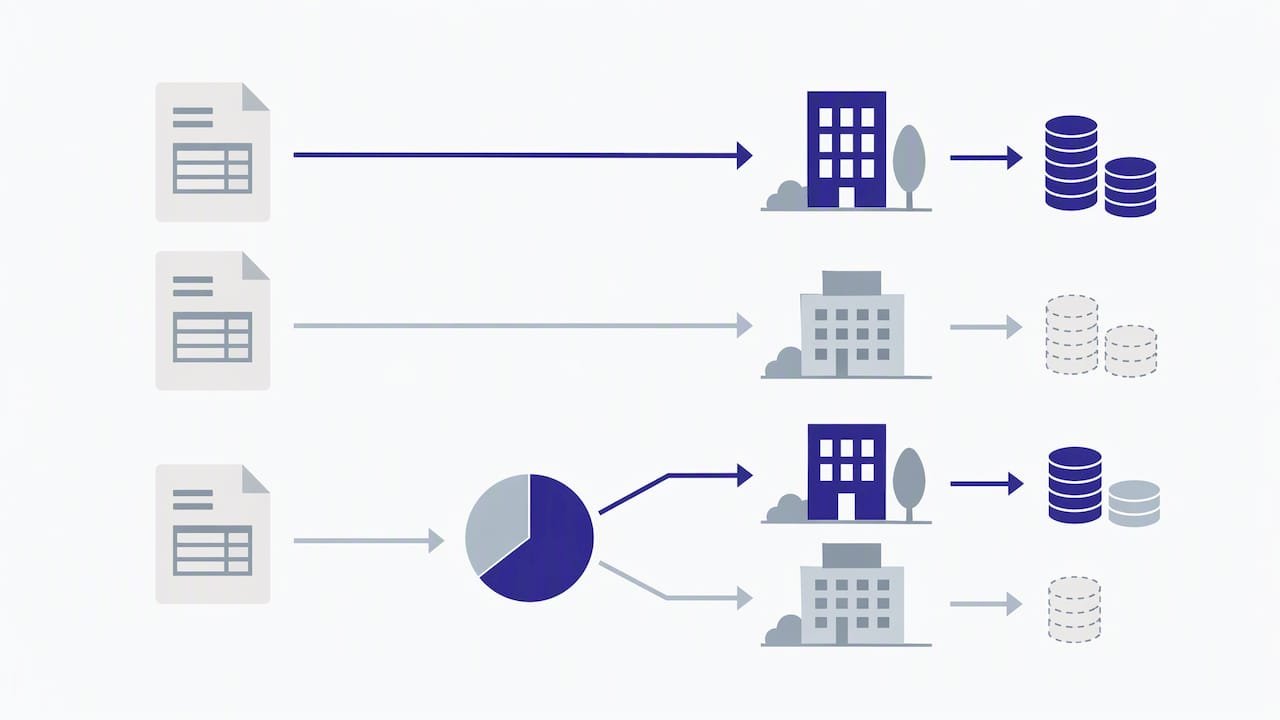
If you have taxable and VAT-exempt sales at the same time, for example as a physiotherapist with medical treatments and a small sale of training equipment, you must allocate every incoming service. Costs that serve only the taxable area are fully deductible, costs only for the exempt area not at all. For jointly used costs such as practice rent or software, input VAT is only deductible proportionally, using a comprehensible allocation key (§ 15 Abs. 4 UStG). Anyone who simply deducts everything across the board risks back payments.
The right time for the input VAT deduction
The question of the month is no small matter: anyone who claims input VAT too early has to correct it later; anyone who claims it too late is effectively providing liquidity to the Finanzamt in advance.
The basic rule of the tax administration: the deduction is possible in the advance return period in which the service was performed and the proper invoice is available. The later of the two events is decisive. Whether you have already paid the invoice is irrelevant according to the Finanzamt NRW. This also applies if you yourself pay VAT on your sales on the basis of payments received.

An example: your web designer delivers the new website on 28 September 2026, and the invoice reaches you on 5 October 2026. According to the administration's view, the input VAT belongs in the October advance return, not in the one for September.
Advance payments: if you pay before the service, the tax attributable to it is already deductible under § 15 Abs. 1 UStG once the invoice is available and the payment has been made. Both conditions must be met. How the advance payment invoice and the final invoice fit together correctly is explained in our guide to instalment invoices and advance payments.
What the EU General Court ruling of February 2026 changes
In its judgment of 11 February 2026 (Case T-689/24), the General Court of the European Union ruled: if the invoice is available at the latest when the tax return is filed, the deduction may not be postponed to a later period. According to this, the right already arises when the service is received. The law firm Ebner Stolz also interprets the ruling this way.
In the website example, this would mean: if the invoice arrives on 5 October and you only file the September advance return after that, you could already claim the input VAT for September. According to BDO, however, the German tax administration has so far stuck to receipt of the invoice. Anyone who deviates from the administration's position should disclose this in the advance return and coordinate with their tax advisor beforehand. For most self-employed people, the safe approach remains: input VAT goes into the month in which the invoice is received.
Input VAT without a classic invoice: three special cases
Besides the invoice from a domestic business owner, § 15 Abs. 1 UStG provides other routes to input VAT:
- Einfuhrumsatzsteuer (import VAT): if you import goods from a non-EU country, for example from China or Switzerland, you can deduct the import VAT incurred for your business.
- Intra-community acquisition: if you, as a business owner, purchase goods in another EU country, you owe the German acquisition tax and deduct it again as input VAT in the same step.
- Reverse charge under § 13b UStG: for certain services, for example from foreign service providers or for construction services, you as the recipient owe the tax. This tax is also deductible as input VAT if the service was obtained for your business.
In all three cases, the Zahllast (VAT payable) is usually zero on balance, but only if you record both sides correctly in the advance return.
How to secure your input VAT deduction in practice
There is no application for “entitlement to input VAT deduction”. If in doubt, you must prove that every single requirement was met. This routine has proven effective:
- Clarify your status: use your Fragebogen zur steuerlichen Erfassung (tax registration questionnaire) to check whether you are registered under Regelbesteuerung or as a Kleinunternehmer.
- Check every invoice on receipt: mandatory details, your correct business address, tax amount shown, specific description of the service.
- Record the business purpose: for business entertainment, note the occasion and participants; for items with mixed use, document the share of use.
- File documents digitally right away: photos, PDFs and e-invoices should be archived unalterably so that they remain available for years in the event of an audit.
- Choose the right month: post input VAT in the advance return period in which the service and invoice are available, and for advance payments also the payment.
- Meet deadlines: anyone who files the advance return late risks surcharges. The consequences are explained in our guide to late filing and late payment surcharges.
At year-end, the Umsatzsteuererklärung (annual VAT return) consolidates all advance returns. At the latest there, missing or double-posted input VAT amounts will come to light. What applies here is explained under Umsatzsteuererklärung: deadline and final payment.
Our view on the input VAT deduction
Among self-employed people and small businesses, we rarely see input VAT fail because of complicated legal questions. It fails because of everyday life: the fuel receipt is in the glove compartment, the graphic designer's invoice just says “design”, the PDF invoice from the hosting provider disappears in the inbox. Each of these documents is hard cash, and each is missing at the end of the advance return.
That is why we don't think much of collecting documents only at the end of the quarter. Anyone who photographs, checks and allocates an incoming invoice on the day it arrives will still spot missing mandatory details while the supplier can correct them quickly. And they automatically post the input VAT in the right month.
For founders, we have a second piece of advice: don't decide the question of Kleinunternehmer versus Regelbesteuerung solely on the basis of effort. Calculate your planned investments for the first two years. Often this calculation alone shows which option is cheaper.
— Paulo
Recording input VAT properly with Kontelio
Kontelio is built for exactly this routine. You photograph documents as soon as they arrive, work with e-invoices in ZUGFeRD and XRechnung format, archive everything in a legally compliant way and manage your suppliers in one place. From the recorded expenses, Kontelio creates your UStVA and the annual return and submits them directly via ELSTER (official e-filing portal), deadline reminders included. The interface can be used in several languages, in case you prefer not to do your bookkeeping in German.
The Start plan costs €9.90 per month or €99 per year. You can test all plans and prices free of charge for 30 days, without a credit card. You can find out more about the feature on the page about the VAT software.
Frequently asked questions about the input VAT deduction
What does “entitled to deduct input VAT” mean?
Business owners who pay VAT on their sales under the standard rules are entitled to deduct input VAT. They may offset the VAT from incoming invoices for their business against their own VAT liability. Kleinunternehmer under § 19 UStG and private individuals are not entitled.
Do VAT-exempt sales entitle you to deduct input VAT?
As a rule, no: for costs that serve VAT-exempt sales such as medical treatments or residential letting, the deduction is excluded. Exceptions apply, among others, to export supplies and intra-community supplies. For some exemptions, you can waive the exemption under § 9 UStG and thus restore the deduction.
Do I have to have paid the invoice to deduct input VAT?
No. What matters is the service performed and a proper invoice. Only for advance payments made before the service do you additionally need proof of payment.
Can I claim forgotten input VAT later?
Yes, via a corrected advance return or at the latest in the annual VAT return, as long as the tax assessment can still be amended. Post the input VAT in the period to which it belongs, not simply in the current month. For larger amounts or earlier years, it is worth having your tax advisor take a look.
Sources
- § 15 UStG: Input VAT deduction (gesetze-im-internet.de)
- Finanzamt NRW: Input VAT
- Finanzamt NRW: Kleinunternehmerinnen and Kleinunternehmer (small businesses)
- Finanzamt NRW: VAT, an overview
- UStAE section 15.2a: Proper invoice
- UStAE section 14.5: Mandatory invoice details
- Bundesfinanzhof: Invoice requirements for the input VAT deduction
- BDO: News on the timing of the input VAT deduction
- FGS: Retroactive input VAT deduction following EU General Court T-689/24
- Ebner Stolz: Input VAT deduction when the invoice is received later
- Gründerfreunde: Small-value invoices up to 250 euros
Recommendations
This article was machine-translated from German. Only the German version is authoritative.