
Creating an Eigenbeleg: Template, Mandatory Details and Limits

Lost receipt, a parking machine that prints no ticket, a tip in a taxi: with an Eigenbeleg (self-issued receipt) you can still record a business expense properly in your bookkeeping. You create it yourself, informally, by hand or digitally. What matters are a handful of mandatory details, a plausible explanation of why the original Beleg (supporting document) is missing, and your signature. Here you will find an overview of all the details, a template you can copy, three examples from the everyday life of self-employed people, and the limits beyond which an Eigenbeleg no longer helps.
In brief
- An Eigenbeleg is a self-issued substitute record for a business expense when the original Beleg is missing or never existed.
- Mandatory are: document number, date, amount, payee, payment method, reason for the expense, explanation of the missing Beleg, as well as place, date and signature.
- You can claim the expense as Betriebsausgaben (deductible business expenses), but you cannot deduct the Vorsteuer (input VAT) from an Eigenbeleg.
- Eigenbelege are the exception. Anyone who submits many of them attracts the attention of the Finanzamt (local tax office).
- Business entertainment is subject to its own, stricter rules. A simple Eigenbeleg is not enough there.
Table of contents
- What an Eigenbeleg is and when you need one
- Where the Eigenbeleg reaches its limits
- Mandatory details at a glance
- Creating an Eigenbeleg in six steps
- Template to copy
- Three everyday examples
- Receipt photos and digital documents: what is accepted?
- Typical mistakes the Finanzamt objects to
- Our view: the best Eigenbeleg is the one you don't need
- Documents, expenses and tax in one place
- Frequently asked questions about the Eigenbeleg
- Sources
What an Eigenbeleg is and when you need one
Every accounting entry needs a Beleg. That is the basic principle of proper bookkeeping, and it applies to Freiberufler (independent professionals) using an Einnahmenüberschussrechnung just as much as to a small GmbH. Sometimes, however, this Beleg is missing: the till receipt got soaked in the rain, the invoice was lost during a move, or the machine simply doesn't print anything.
Exactly for these cases there is the Eigenbeleg, also called Ersatzbeleg (substitute receipt) or Selbstbeleg. It is a self-issued record of a business expense that replaces the regular Beleg in your bookkeeping. That is why it must contain the same information: the amount, occasion and recipient of the payment, plus an explanation of why no official Beleg is available.
Typical occasions for an Eigenbeleg:
- Lost or illegible receipts, when the retailer can no longer issue a copy.
- Expenses without receipts, for which there never was a receipt: parking machines, tips, coins for lockers, donations into a collection box.
- Transactions between you and your business: private withdrawals, contributions or internal transfers. According to the founders' portal Für-Gründer.de, Eigenbelege are used for these as well; the portal also points out that Betriebsausgaben documented by an Eigenbeleg are deductible, but a Vorsteuerabzug (input VAT deduction) is not permitted.
Where the Eigenbeleg reaches its limits
An Eigenbeleg is a stopgap, not a substitute for proper filing of documents. Before you write one, you should know three limits.
No input VAT from an Eigenbeleg
If you paid €119 gross for materials and only have an Eigenbeleg, you post the full €119 as Betriebsausgaben. You cannot reclaim the €19 Umsatzsteuer (VAT) it contains as input VAT from the Finanzamt, because that requires a proper invoice from the supplier. For self-employed people who charge VAT, the Eigenbeleg is therefore always the more expensive solution. We explain how input VAT and invoice details are connected in our guide to Umsatzsteuer for the self-employed. For Kleinunternehmer (small businesses under the Kleinunternehmerregelung) without input VAT deduction, this point does not matter.
Business entertainment needs its own record
A business meal with a client is not a case for a simple Eigenbeleg. To deduct Bewirtungskosten (business entertainment expenses), the Income Tax Act (EStG) requires written proof of the place, date, participants and occasion of the entertainment as well as the amount of the expenses, and these details must be recorded promptly. That is what the Bewirtungsbeleg (entertainment receipt) is for. What it must contain and what share is deductible is explained in our guide to Bewirtungskosten and the Bewirtungsbeleg.
Eigenbelege are the exception
The Finanzamt views Eigenbelege critically. A few parking fees or one lost receipt a year are normal. If, on the other hand, Eigenbelege for larger amounts appear month after month, it suggests that expenses were constructed after the fact. For high amounts, such as a laptop or a machine tool, you should therefore always try to obtain a copy of the invoice first and use the Eigenbeleg only as a last resort. How many Eigenbelege are unproblematic in your case is best answered by your Steuerberater (tax advisor).
Mandatory details at a glance
With an Eigenbeleg, content matters, not form. A handwritten note is just as valid as a completed PDF, as long as all details are complete, plausible and clearly legible. These fields belong on every Eigenbeleg:
| Detail | What you enter | Example |
|---|---|---|
| Document number | Sequential number with your own prefix | E-2026-014 |
| Date of the expense | Day on which you paid | 14.10.2026 |
| Amount | Gross amount in euros, with the tax rate if possible when VAT applies | €4.50 |
| Payee | Name and, if known, address | Parkhaus am Hauptbahnhof, Cologne |
| Payment method | Cash, EC card, credit card, bank transfer, PayPal | Cash |
| Reason for the expense | Specific business occasion | Parking for client appointment at Müller company |
| Explanation | Why there is no original Beleg | Machine did not issue a receipt |
| Place, date, signature | Where and when you created the document | Cologne, 14.10.2026, signature |
In practice, two fields decide whether an Eigenbeleg is convincing: the reason for the expense and the explanation for the missing Beleg. “Office supplies” is too thin. “Printer paper and toner for the office, bought at Schreibwaren Weber, receipt lost in transit” is comprehensible.
Creating an Eigenbeleg in six steps
- Look for the original first. Check emails, customer accounts at online shops and apps from petrol stations or DIY stores. Many retailers issue invoice copies on request. A copy is always better than an Eigenbeleg.
- Collect proof of payment. A bank statement, credit card statement or PayPal transaction proves that money was paid. For cash payments, calendar entries, a logbook or emails about the appointment help.
- Assign a document number. Use your own number range, such as E-2026-001, E-2026-002 and so on. That way you and the Finanzamt can recognise Eigenbelege immediately.
- Fill in all mandatory details. Date, amount, payee, payment method, reason and explanation, as in the table above. Don't leave any field empty.
- Sign with place and date. With your signature you confirm that the details are correct.
- Attach proof of payment and post the document. File the Eigenbeleg together with the bank statement and post it like any other Beleg, without input VAT.
Create the Eigenbeleg as promptly as possible. A document created in October for a parking session in January seems less credible than one from the same day.
Template to copy
You don't necessarily need a template, because an Eigenbeleg has no prescribed form. If you prefer a document to print out, Smartvorlagen offers a free Eigenbeleg template as a PDF and Word file. But you can also simply copy the following template by hand or paste it into your own file:
EIGENBELEG No. E-2026-___

Date of expense:        __.__.2026
Amount (gross):         €______   (incl. __ % VAT, if known)
Payee:                  ______________________________
Address:                ______________________________
Payment method:         [ ] cash  [ ] EC card  [ ] credit card
                        [ ] bank transfer  [ ] other: ________
Reason for expense:     ______________________________
                        ______________________________
No original receipt because: _________________________
Attachments:            [ ] bank statement  [ ] appointment/email  [ ] other

Place, date:            ______________________________
Signature:              ______________________________
Save the template once as a file, and your next Eigenbeleg will be done in two minutes.
Three everyday examples
Parking machine without a ticket
A graphic designer parks in the city centre for two hours for a client meeting and pays €4.50 in cash. The machine doesn't print a ticket. Her Eigenbeleg states the date, €4.50, the car park operator, “cash”, as the reason “Parking for client appointment Agentur Schmidt” and as the explanation “Machine without receipt printout”. Her calendar entry serves as the attachment. Done.
Lost till receipt at the DIY store
An electrician buys cables and junction boxes for €37.80 with his EC card. The receipt gets lost on the building site. First he asks the store for a copy. If there is none, he writes an Eigenbeleg, states the materials and the building site as the reason and attaches the bank statement showing the card payment. He posts the full €37.80 as Betriebsausgaben; the input VAT on it is lost.
Private withdrawal and contribution
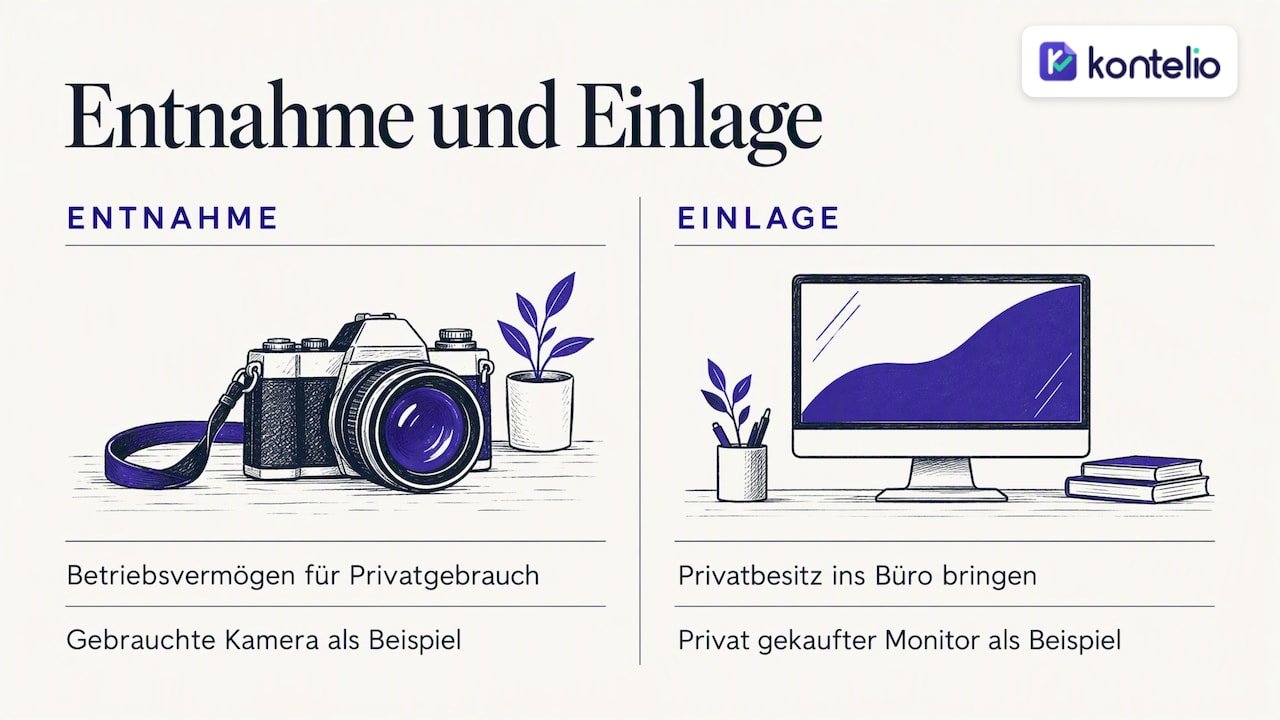
A photographer takes a used camera out of the business assets for private use. This is a withdrawal, and naturally there is no third-party Beleg here. The Eigenbeleg documents the item, the date, the value applied and the reason. You yourself are both payee and payer: once as Unternehmer (business owner), once as a private individual. A contribution works the other way round, for example when you bring a privately purchased monitor into the office. How the value should be determined in such cases and what tax consequences a withdrawal has should be clarified with your tax advisor for larger items.
Receipt photos and digital documents: what is accepted?
Many people wonder whether a photo of the till receipt is enough or whether the paper receipt has to be kept. In principle, the principles for proper bookkeeping in digital form, GoBD (principles for proper electronic bookkeeping) for short, allow paper documents to be captured digitally, including by smartphone. For a receipt photo to be accepted, in practice it must meet a few requirements:
- Complete and legible: The whole receipt is visible; amounts, date and retailer are clearly recognisable.
- Archived immutably: The photo is not just in your phone's gallery but in a system that prevents or logs subsequent changes.
- Filed traceably: Every document is assigned to an accounting entry and can be found throughout the entire retention period.
- Documented process: Anyone who wants to destroy paper documents after scanning needs a Verfahrensdokumentation (process documentation) describing how documents are captured, checked and archived.
Whether you may destroy originals after digitising them depends on your process. If in doubt, keep the paper documents as well until your tax advisor has reviewed your process.
The advantage when it comes to the Eigenbeleg: if you photograph every receipt right after the purchase, you hardly need substitute documents anymore. A crumpled receipt in your jacket pocket is often illegible after three weeks; the photo from the moment of purchase is not. Read more about digital filing on our page about GoBD-compliant document management.
Typical mistakes the Finanzamt objects to
- Generic explanations: “Receipt missing” without explaining why is not enough.
- Round estimated amounts: €50.00 for a purchase looks estimated. Enter the actual amount, taken from the bank statement if necessary.
- Missing business occasion: The reason must make clear why the expense belongs to the business.
- Input VAT posted: Anyone who deducts input VAT from an Eigenbeleg risks a correction including back payment.
- Eigenbeleg instead of Bewirtungsbeleg: Business entertainment follows its own rules.
- Collected after the fact: A stack of Eigenbelege, all written on 30 December, invites queries.
An overview of which costs you can deduct as Betriebsausgaben in the first place helps you phrase the business occasion correctly.
Our view: the best Eigenbeleg is the one you don't need
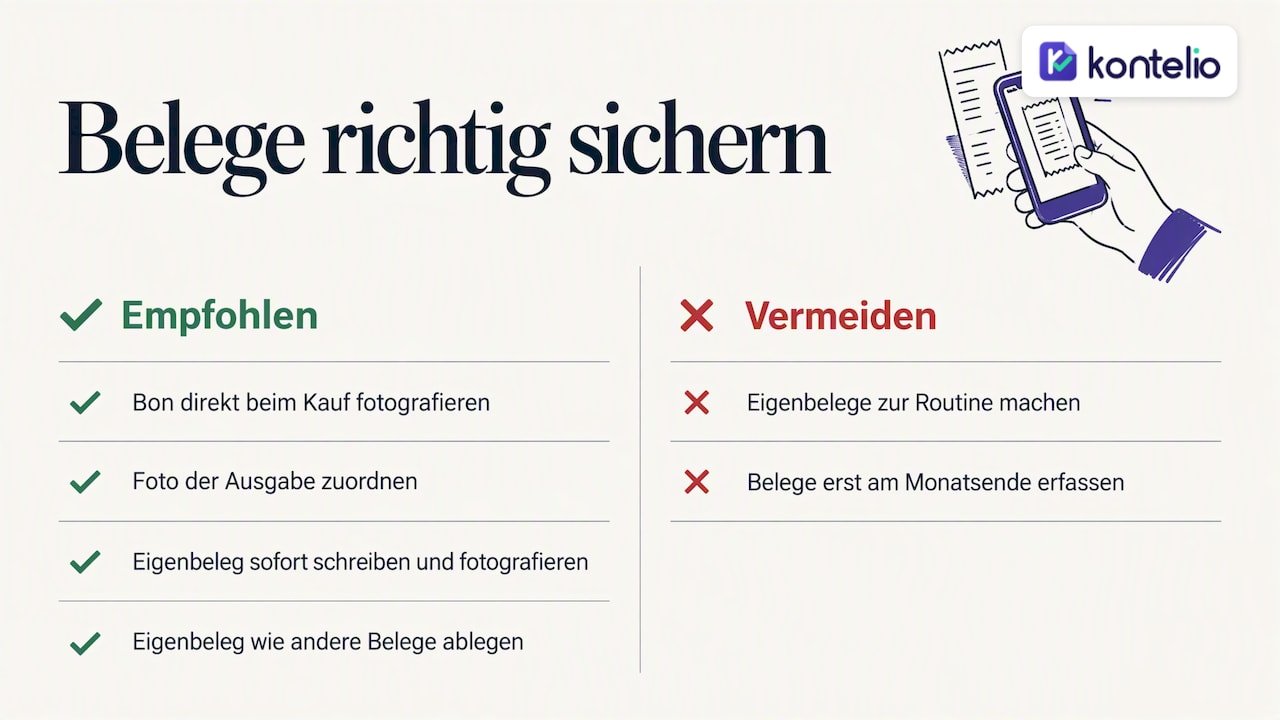
We see Eigenbelege as a tool for exceptions, not as part of the routine. Almost every Eigenbeleg has a backstory: a receipt wasn't recorded right away, ended up in the glove compartment and was gone by the end of the month. That is why at Kontelio we focus on the moment of purchase. If you photograph the receipt directly with your smartphone and assign it to the expense, you have archived it in a legally compliant way before it can get lost.
If a gap remains, for example with a parking machine that doesn't issue a ticket, write the Eigenbeleg right away, photograph it and file it just like any other Beleg. That way it sits in the system next to the bank statement, with the same traceability. And anyone who works with customers or suppliers in several languages should still be able to keep their books in the language in which they can phrase the explanation most clearly. In the end, a good explanation is what makes an Eigenbeleg credible.
— Paulo
Documents, expenses and tax in one place
With Kontelio you capture documents by photo upload, assign them to your expenses and archive them in a legally compliant way. Your posted documents form the basis of your Einnahmenüberschussrechnung (EÜR, cash-basis income/expense statement) and your Umsatzsteuer-Voranmeldung (UStVA, periodic advance VAT return), which you submit directly via ELSTER (official e-filing portal). Deadline reminders ensure nothing gets left behind. The Start plan costs €9.90 per month or €99 per year. You can find all plans on our pricing page, and you can try Kontelio free for 30 days, no credit card required.
Frequently asked questions about the Eigenbeleg
Who is the payee on an Eigenbeleg?
The payee is the person or company you paid the money to, for example the car park operator or the DIY store. Enter the name and, if known, the address. For private withdrawals and contributions, you yourself are both sides, once as Unternehmer and once as a private individual.
What should I do if the till receipt has been lost?
First ask the retailer for a copy of the invoice; many can reprint receipts via the card payment or customer account. If that doesn't work, create an Eigenbeleg with all mandatory details and attach the proof of payment. You can then no longer deduct the input VAT on this purchase.
Can I write an Eigenbeleg by hand?
Yes. The form is free; all that matters is that all details are complete, plausible and legible. A handwritten Eigenbeleg with a signature is just as valid as a printed form.
Is there an amount limit for Eigenbelege?
No fixed amount limit is laid down for Eigenbelege. However, the higher the amount, the more closely the Finanzamt checks, and the more important proof of payment such as bank statements becomes. For larger purchases you should always request a copy of the invoice instead of relying on an Eigenbeleg.
Is an Eigenbeleg enough for a business meal?
No. For business entertainment, the Income Tax Act requires a separate record with the place, date, participants, occasion and amount of the expenses. Use a Bewirtungsbeleg for this and fill it in promptly.
Sources
- Federal Ministry of Finance (BMF): Official Income Tax Handbook 2025, Appendix 16 II
- EXPERTE.de: Creating an Eigenbeleg
- EXPERTE.de: Eigenbeleg template and mandatory details
- Für-Gründer.de: Creating an Eigenbeleg
- Smartvorlagen: Eigenbeleg template as PDF and Word
Recommendations
This article was machine-translated from German. Only the German version is authoritative.