
Kleinunternehmer Invoice 2026: Mandatory Details, Note and Template

As a Kleinunternehmer (small business owner), you write invoices without Umsatzsteuer (VAT). Still, it doesn’t work without rules. Since 2025, a separate, shorter list of mandatory details applies to you. One sentence must not be missing from any invoice: the note that the tax exemption for small businesses applies to your service. Here you will find all the details, proven wordings for the note and a complete template you can replicate. On top of that come the mistakes that can cost you money if things go wrong.
In a nutshell
- In 2026, you are a Kleinunternehmer if your total turnover in 2025 was no more than €25,000 and you are not expected to exceed €100,000 in 2026.
- Only six details are mandatory under § 34a UStDV (VAT Implementation Ordinance): names and addresses, Steuernummer (tax number), date of issue, service, amount and the note on the tax exemption.
- You state a single amount, without net, without gross and without VAT.
- If you state VAT anyway, you owe it to the Finanzamt (local tax office).
- You must be able to receive E-Rechnungen (e-invoices). As a Kleinunternehmer, you do not have to issue them.
Table of contents
- Who invoices as a Kleinunternehmer in 2026
- These details must be on your invoice
- The note on § 19 UStG: wordings that work
- Net, gross or simply one amount?
- Template: what a Kleinunternehmer invoice looks like
- Writing an invoice in six steps
- Typical mistakes and how to avoid them
- E-Rechnung: what applies to Kleinunternehmer
- Invoices to customers abroad
- Our view: a good invoice is created once, not every time
- Writing invoices with Kontelio
- Frequently asked questions
- Sources
Who invoices as a Kleinunternehmer in 2026
Before we get to the invoice, it is worth taking a quick look at the requirements. Under § 19 UStG (VAT Act), your turnover is VAT-exempt if your total turnover in the previous calendar year did not exceed €25,000 and is not expected to exceed €100,000 in the current calendar year. For 2026 this means: what counts is your turnover from 2025 and your forecast for 2026.
With the Jahressteuergesetz 2024 (Annual Tax Act 2024), a number of things changed on 1 January 2025. The BMF (Federal Ministry of Finance) circular on the new version of § 19 UStG explains the new rules in detail. Two points are particularly important for your invoices:
- Turnover is now VAT-exempt. In the past, the tax was “not levied”; today the turnover is a VAT-exempt supply. That is why newer wordings refer to a “tax exemption”.
- The €100,000 limit takes effect immediately. If you exceed it during the current year, the Kleinunternehmerregelung (small-business VAT scheme) does not end only in the following year. From the transaction with which you exceed the limit, you invoice with VAT.
If you are just starting your business, a stricter benchmark applies in the first year: the €25,000 limit already counts for the current year. How to keep an eye on the limits and when it pays to opt out of the scheme is explained in detail in our guide to the Kleinunternehmerregelung 2026.
These details must be on your invoice
For Kleinunternehmer, § 34a UStDV sets out the minimum details. The list is shorter than for a regular invoice under § 14 UStG. A sequential invoice number and the date of supply are not included. Nevertheless, we recommend both, for practical reasons: customers ask for them, and your bookkeeping becomes clearer. At the latest when you switch to Regelbesteuerung (standard VAT taxation), you will need both anyway.
| Detail | Mandatory under § 34a UStDV | Our recommendation |
|---|---|---|
| Your full name and address | Yes | As in your trade registration or tax assessment |
| Full name and address of the customer | Yes | For companies, the exact company name |
| Steuernummer, USt-IdNr. (intra-EU VAT identification number) or Kleinunternehmer identification number | Yes, one of them | The Steuernummer is sufficient within Germany |
| Date of issue | Yes | The day you write the invoice |
| Quantity and type of goods or scope and type of service | Yes | Be specific: hours, number of items, period |
| Consideration as a single sum | Yes | One amount, no tax breakdown |
| Note on the tax exemption for Kleinunternehmer | Yes | With reference to § 19 UStG |
| Invoice number | No | Yes, sequential, e.g. 2026-014 |
| Date or period of supply | No | Yes, e.g. “Period of supply: September 2026” |
| Bank details and payment terms | No | Yes, so you get paid faster |
A few practical tips on the individual fields:
Steuernummer instead of Steuer-ID. What is meant is the Steuernummer that the Finanzamt has issued for your business. Your personal, eleven-digit Steuer-ID (personal tax ID number) does not belong on the invoice. If you do not want to display your Steuernummer publicly, you can apply for a USt-IdNr. from the BZSt (Federal Central Tax Office) and state that instead.
Description of the service. “Consulting” is usually not enough. Write what you did: “Design of three social media graphics for the autumn campaign” or “12 hours of programming, shop integration”. That way the invoice can later be clearly assigned to an order.
One amount. You can show discounts or early payment discounts. In the end, however, there is only one total that your customer pays.
The note on § 19 UStG: wordings that work
The law does not prescribe a fixed wording. It only requires a note that the tax exemption for Kleinunternehmer applies. These sentences have proven themselves:
- “Gemäß § 19 UStG wird keine Umsatzsteuer berechnet.” (“No VAT is charged pursuant to § 19 UStG.”)
- “Steuerfreie Leistung als Kleinunternehmer nach § 19 Abs. 1 UStG.” (“VAT-exempt supply as a Kleinunternehmer under § 19(1) UStG.”)
- “Als Kleinunternehmer im Sinne von § 19 Abs. 1 UStG wird keine Umsatzsteuer ausgewiesen.” (“As a Kleinunternehmer within the meaning of § 19(1) UStG, no VAT is shown.”)
- “Im Rechnungsbetrag ist keine Umsatzsteuer enthalten, da die Steuerbefreiung für Kleinunternehmer nach § 19 UStG gilt.” (“The invoice amount does not include VAT, as the tax exemption for Kleinunternehmer under § 19 UStG applies.”)
The second variant fits the new legal situation best, because it explicitly refers to a VAT-exempt supply. The first is the most widespread and immediately understandable for your customers. What matters is that the note is clearly visible near the invoice amount and not hidden in the small print of the footer.
Avoid wordings such as “VAT-free” without justification or just “Kleinunternehmer”. They leave open on what basis you are not charging tax and lead to queries, especially from business customers.
Net, gross or simply one amount?
This question comes up all the time, and the answer is simpler than you might think: as a Kleinunternehmer, there is no distinction between net and gross for you. You do not charge VAT, so your price is the final price. On the invoice, you therefore write “Gesamtbetrag” (total amount) or “Rechnungsbetrag” (invoice amount). “Nettobetrag” (net amount) and “Bruttobetrag” (gross amount) have no place there.
Why this is so important: anyone who receives an invoice showing a tax amount could deduct input VAT from it. That is why § 14c UStG states: anyone who shows VAT on an invoice without being entitled to do so owes the amount shown. This applies particularly to Kleinunternehmer. Even a note such as “incl. 19 % VAT” can be treated as a tax statement, even though you did not add any tax.
A worked example shows how expensive this can get. You issue an invoice for €1,190.00 and write underneath “including 19 % VAT (€190.00)”. You then owe the Finanzamt €190.00, even though you are a Kleinunternehmer. The good news: such a tax statement can be corrected. How to properly correct an incorrect invoice is shown in our guide to Stornorechnung and Rechnungskorrektur (cancellation and correction invoices).
You should also be consistent with prices on your website or in quotes. “Price: €450” is correct. “€450 plus VAT” is wrong and causes misunderstandings, because your customer then expects a tax surcharge that you are not even allowed to charge.

Template: what a Kleinunternehmer invoice looks like
The following example contains all mandatory details and the additions we recommend. Name, addresses and numbers are entirely fictitious. A similar template is also provided by the IHK (Chamber of Industry and Commerce) as a PDF template for Kleinunternehmer.
Lena Hoffmann · Graphic Design
Lindenstraße 12, 50674 Köln
Tax number: 214/5123/4567

To:
Bäckerei Krüger GmbH
Mr Jonas Krüger
Marktplatz 3, 50667 Köln

Invoice No. 2026-031
Invoice date: 20.10.2026
Period of supply: 01.10.2026 to 15.10.2026

Item  Service                                    Qty     Unit price    Total
1     Logo revision incl. 3 drafts               1       650,00 €      650,00 €
2     Flyer design DIN A5, double-sided          1       350,00 €      350,00 €
3     Product photo editing                      5 hrs   50,00 €       250,00 €

Total amount                                                          1.250,00 €

No VAT is charged pursuant to § 19 UStG.

Please transfer the amount by 03.11.2026 to the following account:
Lena Hoffmann · IBAN DE00 0000 0000 0000 0000 00 · Musterbank Köln
Pay attention to three things when replicating it. First: below the items there is only “Total amount”, no intermediate line for taxes. Second: the note on § 19 UStG is directly below the amount. Third: the invoice number follows a system that you keep up all year, such as the year plus a sequential number.
Writing an invoice in six steps
- Check customer details. For companies, get the exact company name and address, ideally from the imprint or the order.
- Assign a number. Take the next free number from your number sequence. No gaps, no duplicates.
- Describe the service. Quantity, type and period so specifically that even an outsider understands what is being paid for.
- Calculate the amount. Unit prices times quantity, deduct discounts, form a total. Do not add VAT.
- Insert the note. Place the sentence on § 19 UStG directly below the total amount.
- Send and file. Send it as a PDF by email or on paper and archive a copy in an unalterable form. Invoices are among your accounting vouchers, which you must keep for several years.
What generally belongs on an invoice, even outside the Kleinunternehmerregelung, can be found in our overview on writing invoices as a self-employed person.
Typical mistakes and how to avoid them
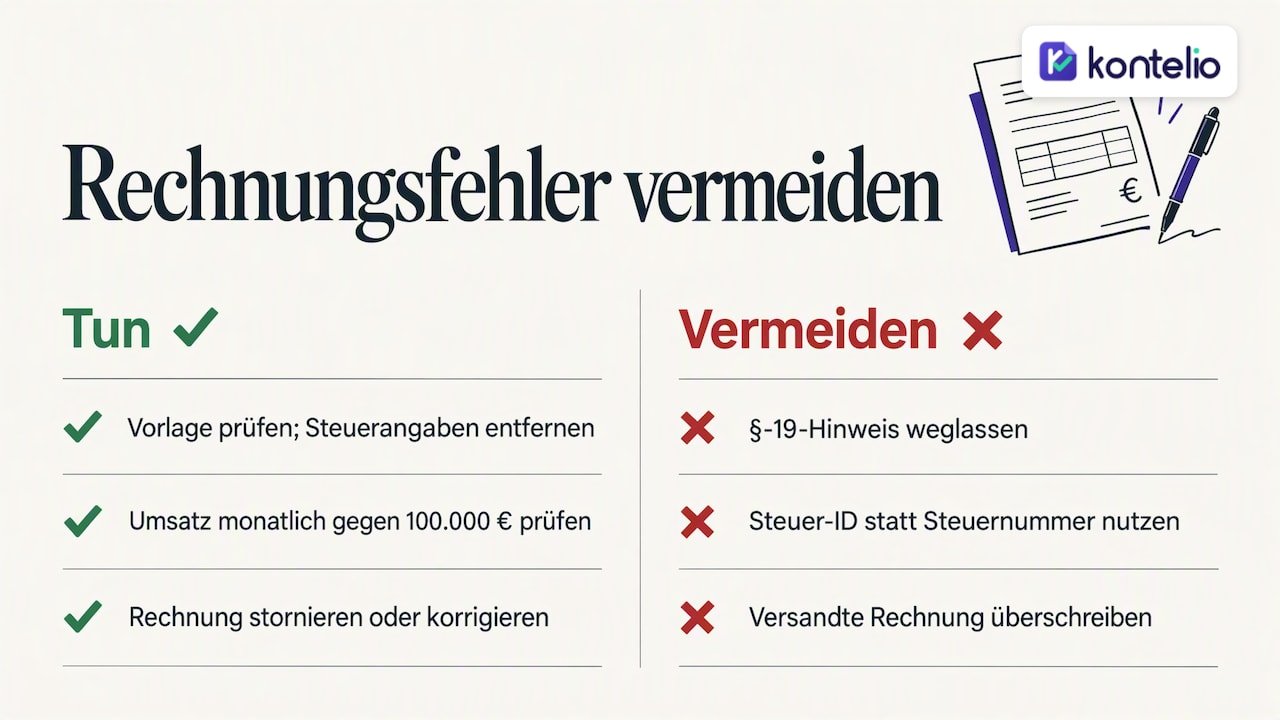
VAT shown out of old habit. This often happens when templates from the internet are adopted without checking. Check every template before you use it for the first time: if it says “MwSt.”, “USt.”, “VAT” or a percentage anywhere, it has to go.
Note forgotten. Without the note, the recipient cannot tell why no tax was charged. Business customers often send such invoices back, and you wait longer for your money.
Limit exceeded and still invoicing without tax. Since 2025, this is particularly tricky, because the €100,000 limit takes effect immediately in the current year. So keep an eye on your turnover every month, not just when you do your tax return.
Steuer-ID stated instead of Steuernummer. The personal tax ID number is intended for income tax and is out of place on the invoice.
Invoice overwritten afterwards. You do not simply change an invoice in the file once it has been sent. You cancel it or issue a correction so that your bookkeeping remains traceable.
Are you unsure whether your turnover in 2026 is still below the limits? Or have you already shown tax by mistake? Then talk to a tax advisor before you send your next invoices. The sooner the mistake is corrected, the less effort it takes.
E-Rechnung: what applies to Kleinunternehmer
Since 1 January 2025, new rules apply to invoices between domestic businesses. The Federal Ministry of Finance summarises them in its questions and answers on the E-Rechnung. For you, this means two things:
- You must be able to receive them. Even as a Kleinunternehmer, you must accept E-Rechnungen in a structured format, such as XRechnung (German e-invoice format) or ZUGFeRD (hybrid e-invoice format). An email inbox is sufficient for receiving them, but you must store the files properly.
- You do not have to issue them. For your own VAT-exempt Kleinunternehmer transactions, you may continue to write PDF or paper invoices. Sending an E-Rechnung voluntarily is permitted.
Nevertheless, it pays not to put the topic off. Many business customers are switching their bookkeeping to structured formats and process them faster. And as soon as you grow beyond the turnover limits, the obligations of businesses under standard taxation apply to you. We explain the timelines and formats in our guide to the E-Rechnung obligation 2025, 2027 and 2028. Invoicing programs differ mainly in formats, archive and ease of use. Industry comparisons such as this one on bookkeeping software for recruitment agencies show this too: which solution fits depends on how and to whom you invoice.
Invoices to customers abroad
If you work for customers outside Germany, things get more complicated. For services to businesses abroad, the place of supply is often in the customer’s country. You may then need a different note on the invoice than the sentence on § 19 UStG, and your customer may have to pay the tax in their country.
If you want to operate as a Kleinunternehmer in several EU countries, since 2025 there has also been the special procedure under § 19a UStG with its own Kleinunternehmer identification number. The BMF circular explains this as well. For your first order abroad: have the invoice checked once by a tax advisor and then use it as a template.
Our view: a good invoice is created once, not every time
With founders, we see the same pattern again and again. The first invoice is created in a word processor, the second is copied from the first. At some point a wrong number appears on it, the note is missing, or a “plus VAT” from an old template creeps in after all. The problem is rarely a lack of knowledge. It is the manual repetition.
That is why we recommend defining the structure of a Kleinunternehmer invoice properly once: sender, Steuernummer, number sequence, note on § 19 UStG, payment terms. After that, you only change what really changes, namely customer, service and amount. This is exactly how we built Kontelio: the software adapts to your business, not the other way round. And because many self-employed people in Germany prefer to think about numbers in another language, Kontelio can also be used in several languages. The invoice has to be right; the way to get there may be convenient.
— Paulo
Writing invoices with Kontelio
With Kontelio invoices, you create invoices and manage customers, suppliers and supporting documents in one place. You can also create E-Rechnungen in ZUGFeRD and XRechnung format. You archive supporting documents in a legally compliant way, and deadline reminders help you not to miss anything. When you later prepare your EÜR (cash-basis income/expense statement) or Umsatzsteuer, you file them directly via ELSTER (official e-filing portal).
You can try Kontelio free of charge for 30 days, without a credit card. After that, the Start plan costs €99 per year or €9.90 per month. You can find all plans on the Kontelio pricing page.
Frequently asked questions
Do I have to assign an invoice number as a Kleinunternehmer?
Under § 34a UStDV, the invoice number is not one of the mandatory details for Kleinunternehmer. We still recommend it, because it allows you to clearly identify invoices and customers often need it for their own bookkeeping. A simple system such as “2026-001” is sufficient.
May I write “net” on my invoice?
Better not. As a Kleinunternehmer, you do not charge VAT, so your invoice amount is the final amount. Write “Total amount” and place the note on § 19 UStG underneath; then it is clear to everyone that no tax is due.
What happens if I have shown VAT by mistake?
Then you owe the amount shown to the Finanzamt under § 14c UStG, even as a Kleinunternehmer. You can correct the invoice by issuing a correction. For larger amounts or several affected invoices, you should consult a tax advisor.
Do I need software for E-Rechnungen as a Kleinunternehmer?
As a Kleinunternehmer, you do not have to issue E-Rechnungen, but you do have to receive and archive them. Invoicing software that can read and file structured formats saves you a lot of manual work. You are also prepared in case you grow beyond the turnover limits.
Sources
- § 19 UStG: Taxation of Kleinunternehmer
- § 34a UStDV: Invoices from Kleinunternehmer
- § 14c UStG: Incorrect or unauthorised tax statement
- BMF circular on the special scheme for Kleinunternehmer (18.03.2025)
- BMF: Questions and answers on the E-Rechnung
- IHK: Invoice template for Kleinunternehmer (PDF)
Recommendations
This article was machine-translated from German. Only the German version is authoritative.