 Black Deal 50% off the first year with annual billing – only until December 31, 2026.

ZUGFeRD or XRechnung: Which E-Invoice Format Is Right for You?
In short, ZUGFeRD (hybrid e-invoice format) and XRechnung (German e-invoice format) do the same job: both are structured E-Rechnungen (e-invoices) under the European standard EN 16931, and you may use either one in Germany for invoices to other businesses. The difference lies in their structure. An XRechnung is a pure XML file that is read by a machine. A ZUGFeRD invoice is a PDF in which the same data is additionally embedded as XML, so people and software can read it equally well. Which format you choose therefore depends less on “better or worse”. What matters is who you send the invoice to and what your recipient requires. In this guide we explain the differences and the profiles, show you typical pitfalls and tell you clearly which format to use when.
In short
- XRechnung is pure XML without a visual view. Public authorities usually require it, and it is the first choice for fully automated processing.
- ZUGFeRD combines a readable PDF with embedded XML. In business-to-business dealings it is often the most convenient solution, because even recipients without e-invoicing software can read the invoice.
- Only ZUGFeRD profiles that meet EN 16931 count as an e-invoice (from the EN 16931 profile, formerly COMFORT). MINIMUM and BASIC WL are not sufficient for this.
- The XML part is always the legally decisive one, including with ZUGFeRD. You must keep it unchanged for eight years.
- You don’t have to commit to one: good bookkeeping software generates both formats. You then choose the right one for each customer.
Table of contents
- What both formats have in common
- XRechnung: the pure data record
- ZUGFeRD: PDF and XML in one file
- The direct comparison
- When to use which format
- The weak spot of ZUGFeRD: when PDF and XML diverge
- Retention: what you need to archive
- Converting XRechnung to ZUGFeRD and vice versa
- When you have to issue e-invoices
- Our view: don’t choose the format, build it in
- Creating e-invoices with Kontelio
- Frequently asked questions
- Sources
What both formats have in common
Since 1 January 2025, a new definition has applied in Germany to invoices between domestic businesses: an E-Rechnung is an invoice in a structured electronic format that allows automatic processing and complies with the European standard EN 16931. A normal PDF sent by email is therefore no longer an e-invoice but a “sonstige Rechnung” (other invoice). The IHK Köln (Cologne Chamber of Industry and Commerce) gives a clear summary of the new e-invoicing rules.
XRechnung and ZUGFeRD are the two common ways in Germany to implement this standard. In terms of content, they carry the same mandatory details: invoice number, date of supply, tax rates, amounts, bank details and information on sender and recipient. They differ in how the data is packaged and who can read it comfortably.
There is also an important bridge between the two. ZUGFeRD has its own profile called XRECHNUNG. According to the FAQ of the Forum elektronische Rechnung Deutschland (FeRD, German Electronic Invoice Forum), this allows the XRechnung standard to be represented directly in the ZUGFeRD format. This already shows that, in practice, the question “ZUGFeRD or XRechnung” is often a question of the right profile, not of picking a side.
XRechnung: the pure data record
The XRechnung is an XML file and nothing else. It contains no graphical view, no logo and no layout. If you open the file without a suitable program, you only see code with tags and values. To display it as a readable invoice, you need software or a viewer that translates the XML into a view.
That sounds like a disadvantage, but it is intentional. Because there is only one source, nothing can diverge. The recipient’s bookkeeping reads the data, checks it and posts it without anyone typing anything in. Public contracting authorities in particular rely on the XRechnung for this reason: they receive large volumes of invoices and want to process them without media breaks.
There are two things you should know about the XRechnung:
- No corporate design. Because of the pure XML structure, no custom layout is possible, as the guide to electronic invoicing in the skilled trades emphasises. Your invoice looks to the recipient however their viewer displays it.
- Recipient details for public authorities. If you invoice federal or state authorities, you usually need a Leitweg-ID (routing ID) from the contracting authority and submit the invoice via the specified portal. Ask for these details as early as when the contract is awarded.
ZUGFeRD: PDF and XML in one file
ZUGFeRD takes a hybrid approach. The invoice is a PDF/A-3, i.e. a normal, readable PDF. An XML file containing the structured invoice data is embedded in this file. Your customer can open, print and check the invoice as usual. Their bookkeeping software reads the XML in the background.
The big advantage lies in the transition. Not every business partner already works fully digitally. A craft business, an association or a small retailer can read a ZUGFeRD PDF without new software. A business with modern bookkeeping, on the other hand, processes it automatically. Your layout is also preserved: your customers see the logo, colours and typeface in the PDF exactly as you designed them.
Since version 2.0 of 24 March 2020, ZUGFeRD and the French format Factur-X have been identical according to FeRD. For you this means that a ZUGFeRD PDF is also understood by customers in France who work with Factur-X.
The ZUGFeRD profiles at a glance
ZUGFeRD is not a rigid format but a family of profiles. According to FeRD, they differ in the scope of mandatory and optional fields and are tailored to businesses of different sizes and complexity. In practice, what matters most is whether a profile counts as an e-invoice.
| Profile | Data scope | Counts as an e-invoice under EN 16931? | Typical use |
|---|---|---|---|
| MINIMUM | header data and totals only | No | booking aid, not sufficient |
| BASIC WL | header and total data without line items | No | booking aid, not sufficient |
| BASIC | with invoice line items, simplified | Yes, as a subset of the standard | simple invoices |
| EN 16931 (formerly COMFORT) | complete according to the standard | Yes | standard for most businesses |
| EXTENDED | standard plus additional fields | Yes | complex industry-specific cases, manufacturing |
| XRECHNUNG | XRechnung rules in the ZUGFeRD container | Yes | when the recipient requires XRechnung data but a PDF is desired |
Our recommendation for self-employed people and small businesses is: use the EN 16931 profile. It covers all mandatory details, is widely accepted and does not overload your invoice with fields you will never need.
The direct comparison
| Criterion | XRechnung | ZUGFeRD (from the EN 16931 profile) |
|---|---|---|
| File format | pure XML file | PDF/A-3 with embedded XML file |
| Human-readable | only with a viewer or software | yes, like a normal PDF |
| Machine-readable | yes | yes, via the XML part |
| Custom layout, logo | not possible | possible in the PDF part |
| Legally decisive | the XML file | the embedded XML data record |
| Typical recipient | public authorities, large companies | businesses of any size |
| Risk of diverging content | none, only one data source | PDF and XML may differ from each other |
| Use abroad | mainly Germany | compatible with Factur-X (France) |
| Retention | XML file unchanged | entire file, at least the XML part unchanged |
When to use which format
The decision is almost always made by the recipient. Go through these questions one by one.
Invoices to public authorities and public contracting bodies
Here the contracting authority specifies the format, and that is usually the XRechnung. Many invoicing portals of the federal and state governments also accept ZUGFeRD, provided the profile is right. Don’t rely on this, but check the tender documents or ask the responsible office. Three things are important here:
- The Leitweg-ID or another buyer reference provided by the contracting authority.
- The transmission channel, i.e. portal, email or the Peppol network.
- The required format and the version of the XRechnung.
Invoices to other businesses
In the B2B sector you may use both formats as long as they comply with EN 16931. However, you and your customer can also agree on another format if the mandatory details can be extracted from it without loss. For most small businesses, ZUGFeRD is the pragmatic standard here. Your customer can read the invoice even if their bookkeeping is not yet automated. And those who already work in an automated way read the XML.
There is one exception you should know about: some larger customers with automated incoming invoice processing explicitly request XRechnung because their system only accepts pure XML. Record this preference in your customer master data. Then you choose the format once and don’t have to think about it again with the next order.
Invoices to private customers and abroad
You don’t have to issue an e-invoice to private individuals. A normal PDF is enough. A ZUGFeRD PDF does no harm, however, because for the private customer it is simply an ordinary PDF. For customers in France, ZUGFeRD is suitable due to its compatibility with Factur-X. For other EU countries, it is better to ask about the desired format; there, the exchange often runs via Peppol. You can read more about this in our overview of XRechnung, ZUGFeRD and Peppol.
A simple rule of thumb
- Recipient is a public authority: XRechnung, unless the requirements explicitly allow ZUGFeRD.
- Recipient is a business with no special request: ZUGFeRD in the EN 16931 profile.
- Recipient requires pure XML: XRechnung.
- Recipient is a private individual: normal PDF or ZUGFeRD, both are fine.
The weak spot of ZUGFeRD: when PDF and XML diverge
The hybrid structure has a catch. A ZUGFeRD file contains two representations of the same invoice, and they can differ. If a poorly programmed tool generates the PDF and the XML separately, the image may show a different amount than the data. In the worst case, the XML is changed afterwards while the PDF remains unchanged. Experts have coined the term “Trojan ZUGFeRD” for this.
As for the question of what applies, the situation is clear. The IHK Köln states that with hybrid formats, the structured part is decisive for VAT purposes. The visible PDF does not replace the XML data record. This results in two practical rules:
- As the sender: always generate the PDF and XML from the same data record in your software, and never by hand or with separate tools.
- As the recipient: post incoming ZUGFeRD invoices on the basis of the XML. If the amount in the PDF differs from it, clarify this with the sender before you pay and claim the Vorsteuer (input VAT). For larger amounts or doubts about the Vorsteuerabzug (input VAT deduction), talk to your Steuerberater (tax advisor).
Retention: what you need to archive
For invoices, a VAT retention period of eight years applies. For e-invoices, the IHK Köln requires at a minimum that the structured part be kept unchanged. Specifically, this means:
- XRechnung: archive the original XML file. A printout or a PDF from the viewer is not enough.
- ZUGFeRD: archive the original file with the embedded XML. Don’t re-save the invoice via “Print as PDF”, because the XML is lost in the process.
The skilled-trades guide to e-invoicing also stresses that at least the structured part must be preserved in its original form. A folder in your email inbox is not a secure archive for this. A better choice is a solution that stores documents in an unalterable way and lets you find them at any time.
Converting XRechnung to ZUGFeRD and vice versa
Technically, conversion is possible, because both formats are based on the same standard. A ZUGFeRD PDF can be generated from an XRechnung by rendering the data as a visual view and embedding the XML. Conversely, the XML can be extracted from a ZUGFeRD file. There are a few things to keep in mind:
- Pay attention to the syntax. XRechnung exists in two technical syntaxes (UBL and CII). ZUGFeRD uses CII. A converter may therefore have to translate.
- The original stays the original. If you have received an XRechnung, that XML file is the invoice you keep. A converted version is only a working copy.
- Don’t lose any data. Only convert to a profile that can hold all fields. Switching from EN 16931 to MINIMUM would cut off mandatory details.
- Check after conversion. Run the new file through a validator before you send it.
The simpler way for senders: generate the format the customer wants right away instead of converting afterwards. If your software generates both formats from the same invoice data, the question doesn’t even arise.
When you have to issue e-invoices
All domestic businesses have had to be able to receive e-invoices since 1 January 2025. For issuing them, transition periods apply: until the end of 2026, businesses may continue to send paper or PDF invoices. Businesses with a prior-year turnover of up to €800,000 may do so until the end of 2027. From 2028, the obligation then applies to all domestic B2B invoices.
Important: the transition periods only concern sending. You already need an inbox where XRechnungen arrive and a way to read them today. We explain the exceptions for small-value invoices and Kleinunternehmer (small businesses) as well as all key dates in detail in our guide to the e-invoicing obligation in 2025, 2027 and 2028. If you want to proceed step by step, our free e-invoice checklist gives you the individual steps to tick off.
Our view: don’t choose the format, build it in
Self-employed people and founders ask us the question “ZUGFeRD or XRechnung?” very often, usually with the undertone that they now have to pick a side. Our honest answer: you don’t have to. Both formats are equivalent e-invoices. Anyone who commits to one unnecessarily shuts themselves off from customers who require the other.
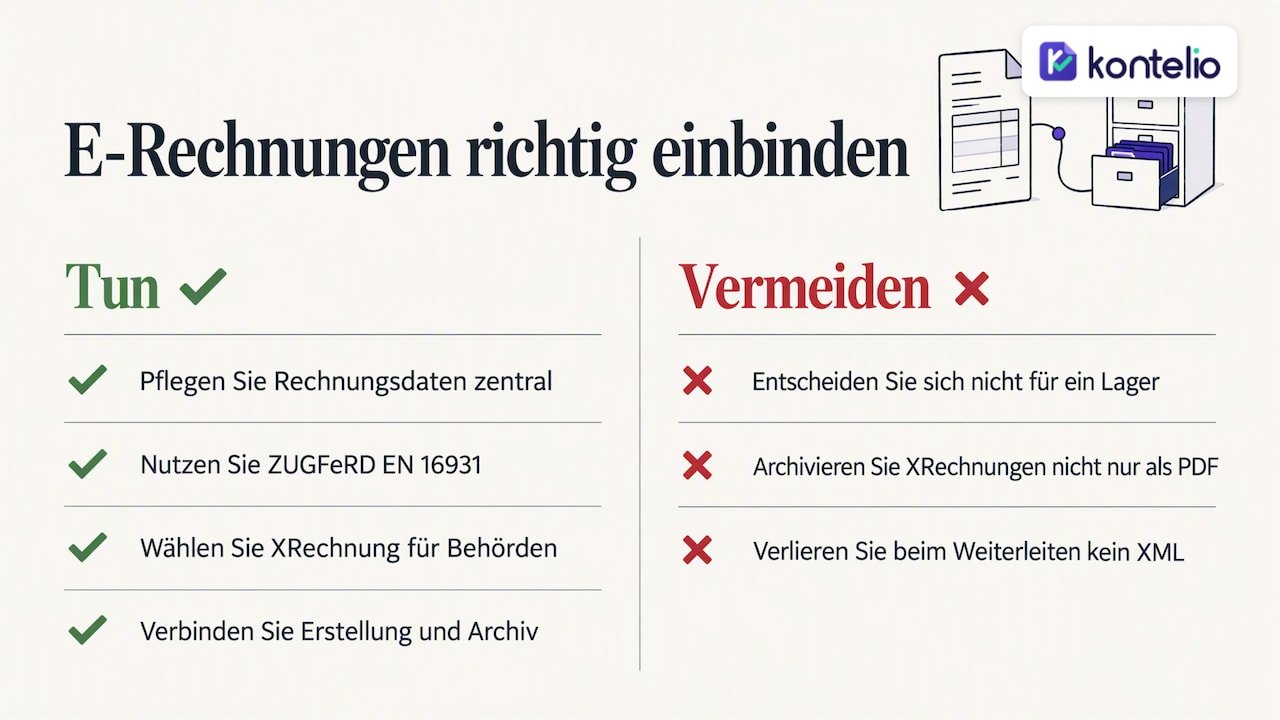
In our view, what matters is something else. Your invoice data should be maintained cleanly in one place: customer, service, tax rate, bank details. The format is then just an output. For most business customers we recommend ZUGFeRD in the EN 16931 profile, because it is human-friendly and can still be processed automatically. For public authorities and for customers with strict requirements, use XRechnung. And save each customer’s preference so you don’t have to think it over again with every invoice.
Incidentally, we see the biggest mistake not in choosing the format but in filing. An XRechnung that is archived only as a PDF printout, or a ZUGFeRD PDF that loses its XML when forwarded: this only comes to light during the Betriebsprüfung (tax audit). You avoid this mistake when creation and archiving are in one system.
— Paulo
Creating e-invoices with Kontelio
With Kontelio you create e-invoices in ZUGFeRD and XRechnung format from the same invoice data. You choose the format for each customer, Kontelio archives your documents in a legally compliant way and reminds you of deadlines. You submit the Umsatzsteuer-Voranmeldung (UStVA, periodic advance VAT return) and the EÜR (cash-basis income/expense statement) directly via ELSTER (official e-filing portal). The interface can be adapted to your business and used in several languages. This helps if German is not your first language or your team works internationally.
You can try Kontelio free for 30 days, no credit card required. After that, you choose a plan: Start for €9.90 per month or €99 per year, Business for €22.90 per month or €199 per year, Pro for €32.90 per month or €299 per year. You can find all details on our pricing page.
Frequently asked questions
Is ZUGFeRD or XRechnung better?
Neither format is fundamentally better. Both meet EN 16931 and count as an e-invoice. XRechnung is suited to public authorities and fully automated processing. ZUGFeRD is usually a better fit for business customers because it additionally contains a readable PDF.
Is every ZUGFeRD invoice an e-invoice?
No. Only profiles that comply with EN 16931, i.e. BASIC, EN 16931, EXTENDED and XRECHNUNG, count as an e-invoice. The MINIMUM and BASIC WL profiles contain too few details. Check in your software which profile it generates.
What alternatives are there to ZUGFeRD?
In Germany, the XRechnung is the most important alternative. Factur-X is identical in content to ZUGFeRD and widespread in France. Larger companies also exchange invoices via EDI procedures or the Peppol network if both sides agree to it.
Can I convert an XRechnung into a ZUGFeRD invoice?
Yes, technically this works because both formats are built on the same standard. However, you must always keep the original file that you received or sent. As the sender, it is easier to generate the format your customer requires right away.
What happens if the PDF and XML in a ZUGFeRD invoice differ?
For VAT purposes, the XML part is decisive, not the visible PDF. You should therefore post on the basis of the XML data and clarify discrepancies with the sender before you pay. As the sender, you avoid the problem by generating both parts from the same data record.
Sources
- IHK Köln: The new e-invoice since 01.01.2025
- FeRD: Frequently asked questions about ZUGFeRD
- Selbstständig im Handwerk: Electronic invoicing in the skilled trades
Recommendations
This article was machine-translated from German. Only the German version is authoritative.