 Black Deal 50% off the first year with annual billing – only until December 31, 2026.

Leistungsdatum on Invoices: Requirements, Format and Consequences

The Leistungsdatum (date of supply) belongs on every invoice you issue in Germany. It shows when you delivered goods or performed your service, and it is a separate mandatory detail alongside the invoice date. If it is missing, your customer cannot reliably deduct the Vorsteuer (input VAT). In addition, the date of supply determines in which month, and sometimes in which year, the Umsatzsteuer (VAT) becomes due. Here you will learn which form the law requires, which short forms are permitted, how to correct an invoice without a date of supply and what to keep in mind at the turn of the year.
In brief
- The date of supply is mandatory: according to § 14 Abs. 4 UStG, the date of issue and the time of the delivery or service belong on the invoice as two separate details.
- The calendar month is sufficient: an exact day is not required; “Leistungszeitraum: März 2026” (period of supply: March 2026) is enough.
- If both dates coincide, the sentence “Leistungsdatum entspricht Rechnungsdatum” (date of supply corresponds to invoice date) is permitted. The same applies to a reference to a clearly identified delivery note.
- If the date of supply is missing, the invoice can be corrected, namely with a document that clearly refers to the original invoice.
- For VAT under Soll-Versteuerung (accrual-basis VAT), what generally counts is the month of the supply, not the month of the invoice. This is especially important in December and January.
Table of contents
- Date of supply, delivery date and invoice date: the difference
- What the VAT Act requires
- How to state the date of supply correctly
- Invoice without a date of supply: consequences and correction
- Date of supply, VAT and the turn of the year
- Checking incoming invoices: a short checklist
- Our view: the date of supply belongs in your workflow, not in your memory
- Writing invoices with a date of supply in Kontelio
- Frequently asked questions
- Sources
Date of supply, delivery date and invoice date: the difference
In everyday business, three terms come up that are often confused. The law actually only knows two details: the date of issue of the invoice and the time of the delivery or other service. “Leistungsdatum” (date of supply) and “Lieferdatum” (delivery date) are two names for the second detail. Which one fits better depends on what you sell.
| Term | What it means | Typical case | Legal basis |
|---|---|---|---|
| Rechnungsdatum (invoice date) | The day on which you issue the invoice | You write the invoice on 5 November | § 14 Abs. 4 Satz 1 Nr. 3 UStG |
| Lieferdatum (delivery date) | Time of a delivery of goods | An online retailer ships a parcel | § 14 Abs. 4 Satz 1 Nr. 6 UStG |
| Leistungsdatum (date of supply) | Time of an other supply, i.e. a service | A designer delivers a finished logo | § 14 Abs. 4 Satz 1 Nr. 6 UStG |
| Leistungszeitraum (period of supply) | Time span for services lasting several days, months or years | Monthly IT support, annual maintenance | § 14 Abs. 4 Satz 1 Nr. 6 UStG, § 31 Abs. 4 UStDV |
Your invoice must therefore make clear when the work was done or the goods were delivered and when you invoiced. The two dates may be the same, but they may also be weeks apart. If you complete a project on 28 October and write the invoice on 3 November, you have a date of supply in October and an invoice date in November.
A third deadline has nothing to do with either date: the payment term. It usually also appears on the invoice, but it is a contractual agreement and not a mandatory VAT detail.
What the VAT Act requires
The mandatory details are set out in § 14 Abs. 4 UStG. Number 3 requires the date of issue, number 6 the time of the delivery or other service. The date of supply is therefore not an internal detail for your bookkeeping. It must be evident from the invoice itself.
An important exception concerns advance payments: if you invoice before the service has been performed, you instead state the time at which you received the money, provided this is known and does not coincide with the date of issue.
How precise the detail has to be is governed by the UStDV (VAT Implementation Ordinance). Under § 31 Abs. 4 UStDV, the calendar month in which you delivered or performed is generally sufficient as the time. This is also confirmed by IHK Ostthüringen in its overview of the mandatory details. An exact day is therefore permitted and often sensible, but not required.
These rules apply equally to paper invoices, PDF invoices and E-Rechnungen (e-invoices). In an XRechnung or ZUGFeRD invoice, the date of supply is held in a structured field instead of somewhere in the running text. You can read which deadlines apply to the E-Rechnung in our guide to the E-Rechnung mandate 2025, 2027 and 2028.
How to state the date of supply correctly
There are several permitted forms. Choose the one that suits your business and that your customer understands without having to ask.
- Specific day: “Leistungsdatum: 14.10.2026” (date of supply: 14 October 2026). Ideal for one-off services such as a workshop or a repair.
- Calendar month: “Leistungszeitraum: Oktober 2026” (period of supply: October 2026). Sufficient under § 31 Abs. 4 UStDV and a good fit for monthly invoices.
- Period: “Leistungszeitraum: 01.07.2026 bis 30.09.2026” (period of supply: 1 July 2026 to 30 September 2026). For quarterly billing, maintenance contracts or project phases.
- Reference to the invoice date: “Das Leistungsdatum entspricht dem Rechnungsdatum.” (The date of supply corresponds to the invoice date.) Only if that is actually true.
- Reference to the delivery note: “Lieferung gemäß Lieferschein Nr. 2026-118 vom 12.10.2026” (delivery as per delivery note no. 2026-118 dated 12 October 2026). The delivery note must be clearly identified.
- For advance payments: “Anzahlung vereinnahmt am 02.10.2026, Leistung voraussichtlich im Dezember 2026” (advance payment received on 2 October 2026, supply expected in December 2026).
IHK Ostthüringen explicitly names the note referring to the invoice date and the reference to a delivery note as permitted options. The Bundesfinanzhof (Federal Fiscal Court) ruled in 2018 that the month of supply can even be derived from the invoice date if, based on the circumstances of the individual case, it is established that the service was performed in the month in which the invoice was issued. However, do not rely on this: the ruling helps in a dispute, but a clean statement saves you the dispute altogether.
You can find an overview of all the other mandatory details, from the Steuernummer (tax number) to the sequential invoice number, in our guide Writing invoices as a self-employed person.
Delivery of goods: which day counts
For goods, the question of which day is the delivery date is less clear-cut than it sounds. The information sheet of the Handwerkskammer Niederbayern-Oberpfalz (Chamber of Crafts) on the time of supply distinguishes between two cases:
- Moved delivery: The goods are transported or shipped. What generally counts is the day on which the transport or shipment begins. If you hand in a parcel on 30 September and it arrives on 2 October, the delivery date falls in September.
- Unmoved delivery: The goods stay where they are, for example when the customer collects them or already has them. Here, the day on which the customer obtains the power of disposal counts.
Especially at the end of the month, this difference shifts the VAT into a different UStVA (periodic advance VAT return) period. If you ship a lot, you should record the shipping date, for example via the delivery note.
Services and periods of supply
For other services, according to the explanation by Haufe on the time of supply, the time of completion generally applies. A copywriter who works on a concept in September and delivers it on 6 October has October as the date of supply.
If the service extends over several months or years, for example a consulting mandate or a hosting contract, you may state the entire period of supply in accordance with § 14 UStG. For partial services that you invoice monthly, you state the respective month on each invoice.
Advance payments and progress invoices
If you issue an invoice for an advance payment, the service has not yet been performed. There is therefore no date of supply yet. Instead, you state the time at which you received the money, if it is known and differs from the invoice date. The final invoice then shows the actual date of supply, and the advance payments are offset. We explain how this works in detail in our guide to progress invoices and advance payment invoices.
Invoice without a date of supply: consequences and correction
If the date of supply is missing, the invoice is incomplete. The consequences are mainly borne by your customer: for the Vorsteuerabzug (input VAT deduction), they need a proper invoice. In the decision mentioned above, the Bundesfinanzhof emphasises that the invoice must make the service clearly and easily verifiably identifiable. Generic details without a sufficient description of the service can rule out the input VAT deduction. You can read which other requirements must be met in our article on the input VAT deduction and its correct timing.
For you as the issuer of the invoice, this means: invoices without a date of supply lead to queries, delayed payments and, in the event of a tax audit at the customer's business, unpleasant corrections.
The good news: the error can be fixed. Under § 31 Abs. 5 UStDV, you can correct an invoice by providing the missing or incorrect details in a document that refers specifically and unambiguously to the original invoice. Here is how to proceed:
- Check what is missing: Only the date of supply, or other details as well? Note the actual day, month or period of the supply.
- Create a correction document: For example, “Berichtigung zur Rechnung Nr. 2026-047 vom 15.09.2026: Der Leistungszeitraum ist August 2026.” (Correction to invoice no. 2026-047 dated 15 September 2026: the period of supply is August 2026.) The invoice number and date of the original invoice must be stated.
- Alternatively, reissue: You can also cancel the invoice and issue a complete new invoice that refers to the old one. The invoice numbering remains sequential.
- Archive both documents: The original invoice and the correction belong together in your document filing.
- Inform the customer: Send the correction to the same place as the original invoice so that it ends up with the right document there.
Important for the customer: the Bundesfinanzhof generally recognises a retroactive correction if the original invoice already contained details of the issuer, the recipient of the service, the description of the service, the consideration and the separately shown VAT. So if only the date of supply is missing, the input VAT deduction is usually preserved in the original period. At the same time, § 14 UStG makes clear that such a correction is not a retroactive event within the meaning of the AO (German Fiscal Code), and therefore does not in itself trigger new interest periods. If an input VAT deduction is already disputed during an audit, speak to your tax advisor before submitting any documents.
Date of supply, VAT and the turn of the year
This is where the date of supply becomes expensive or favourable for you yourself. The question is always: in which period must you pay the VAT, and in which year does the turnover count?
Soll- or Ist-Versteuerung
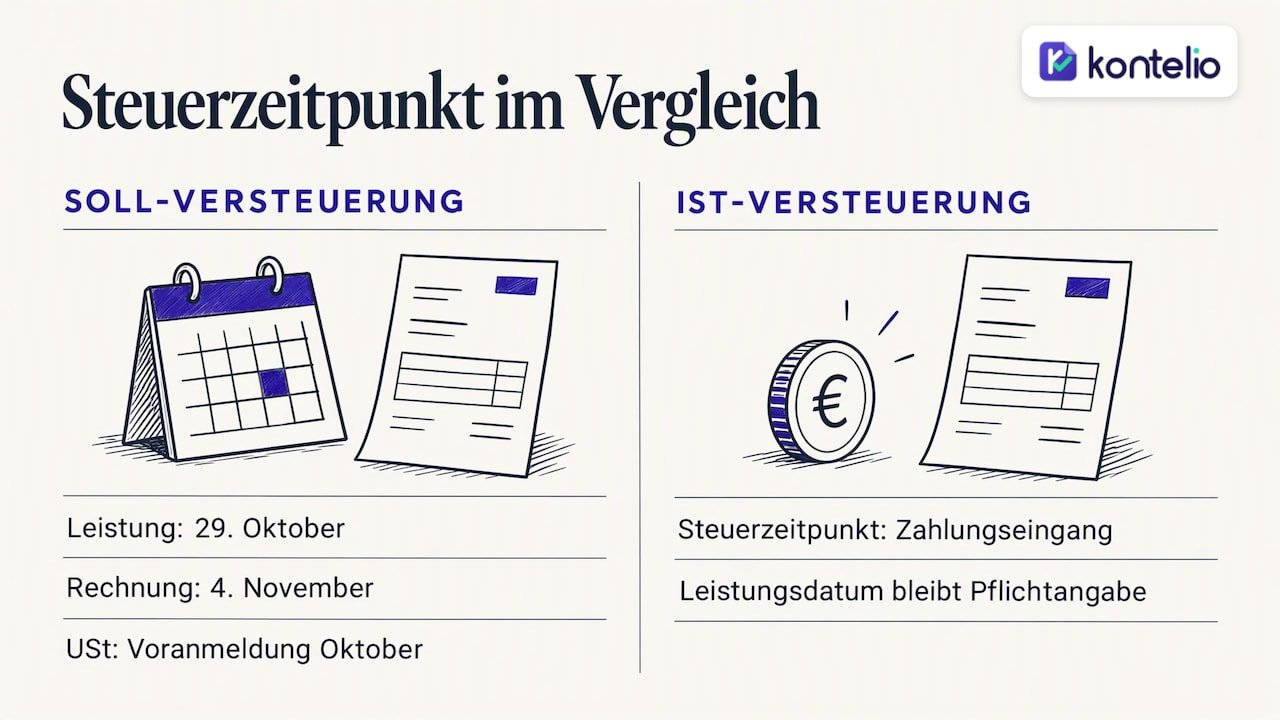
Under Soll-Versteuerung (accrual-basis VAT), VAT generally arises under § 13 UStG at the end of the UStVA period in which you performed the supply. What matters is therefore the date of supply, not the invoice date and not the receipt of payment. Special rules apply to advance payments: here the tax arises upon receipt of the money.
Under Ist-Versteuerung (cash-basis VAT), which many self-employed people with lower turnover use upon application, the receipt of payment counts instead. The date of supply nevertheless remains a mandatory detail on the invoice.
An example with Soll-Versteuerung and a monthly UStVA: you complete a project on 29 October and write the invoice on 4 November. The VAT belongs in the UStVA for October, even though the invoice is only created in November. You can find the deadlines and Kennzahlen (official form field codes) in our guide to the Umsatzsteuer-Voranmeldung (UStVA).
Performed in December, invoiced in January
The classic case at the turn of the year: the work is finished in December, but the invoice only goes out in January. Under Soll-Versteuerung, the VAT belongs to the old year, and therefore in that year's Umsatzsteuererklärung (annual VAT return). If you leave December invoices lying around, you will have to correct the December UStVA later. We explain the deadlines that apply to the annual return in our article on the Umsatzsteuererklärung and final payment.
For profit determination, the situation differs depending on the method:
- EÜR (cash-basis income/expense statement): What generally counts is when the money flows. If your customer pays for the December service in January, that is income of the new year. For regularly recurring payments around the turn of the year, there is a special rule that you should clarify with your tax advisor.
- Balance-sheet accounting: Income and expenses are allocated to the fiscal year in which they arose economically. A service performed in December is income of the old year, even if the invoice is written in January.
The date of supply is therefore a detail that fixes the same month for VAT and the balance sheet, while under the EÜR the payment date determines the profit. Anyone switching from the EÜR to balance-sheet accounting in particular should keep this in mind.
Checking incoming invoices: a short checklist
The date of supply is not only important on your own invoices. On invoices you receive, it helps determine whether you can deduct the input VAT and in which month. Check every incoming invoice:
- Does the invoice show a date of supply, a month, a period or a permitted reference?
- Does the detail match what actually happened? A date of supply after the invoice date is possible with invoices issued in advance, but should make you pause briefly.
- Does the supply fall in a different year from the invoice? Then allocate the VAT and, with balance-sheet accounting, the expense to the correct year.
- If the date is missing, ask the supplier for a correction under § 31 Abs. 5 UStDV before you claim the input VAT.
- On invoices in English, the field is usually called “Date of Supply” or “Service Period”. You can find more terms in our article on invoices in English.
If you invoice without VAT as a Kleinunternehmer (small business under the Kleinunternehmerregelung), you must also state the date of supply. Our template for the Kleinunternehmer invoice shows which mandatory details and which note belong on your invoice.
Our view: the date of supply belongs in your workflow, not in your memory
We keep seeing the same pattern among self-employed people and small businesses: the date of supply is not forgotten because it is complicated, but because the invoice is written in a quiet moment days or weeks after the work. By then, nobody knows exactly whether the project was finished on 30 September or on 2 October, and it is precisely this difference that decides the UStVA period.
Our advice is therefore pragmatic. Record the completion of a service when it happens, not only when you write the invoice. Use the calendar month if the exact day does not matter; it is legally sufficient and less error-prone. Only write “Leistungsdatum entspricht Rechnungsdatum” if you deliver and invoice on the same day, and not as standard text in every template. And in December, review every open service before the year ends.
If you work this way, you will rarely need a correction and will face no VAT surprises at the turn of the year.
— Paulo
Writing invoices with a date of supply in Kontelio
With Kontelio, you write invoices and E-Rechnungen in ZUGFeRD and XRechnung format, record expenses and receipts via photo upload and prepare your Umsatzsteuer-Voranmeldung (UStVA), Umsatzsteuererklärung and EÜR. Submission runs directly via ELSTER (official e-filing portal), deadline reminders help you never miss a UStVA, and your documents are archived in a legally compliant way. You can use the interface in your preferred language.
You can try Kontelio free of charge for 30 days, without a credit card. After that, you choose a plan: Start for €9.90 per month or €99 per year, Business for €22.90 per month or €199 per year, Pro for €32.90 per month or €299 per year. You can find all the details on our page with the prices and plans.
Frequently asked questions
Does the date of supply have to be an exact date?
No. Under § 31 Abs. 4 UStDV, the calendar month in which you delivered or performed is sufficient, for example “Leistungszeitraum: September 2026” (period of supply: September 2026). An exact day is permitted and often helpful for deliveries at the end of the month.
May the date of supply be after the invoice date?
Yes, for example if you invoice in advance, such as for an annual contract. For advance payments, instead of the date of supply you state the time at which you received the money. The final invoice then shows the actual date of supply.
Is an invoice without a date of supply invalid?
It is not a proper invoice and can make the input VAT deduction more difficult for your customer. However, you can correct it by supplying the date of supply in a document that clearly refers to the original invoice. If the original invoice contains the other core details, the correction usually has retroactive effect.
Which date do I use to post an incoming invoice?
For the input VAT, you need a proper invoice; the date of supply helps determine to which period the supply is allocated. With balance-sheet accounting, the expense counts in the year in which the supply arose economically. Under the EÜR, the day of payment generally counts.
Sources
§ 14 UStG: Issuing invoices § 31 UStDV: Details on the invoice IHK Ostthüringen: Mandatory invoice details Bundesfinanzhof: Date of supply derived from the invoice date Handwerkskammer Niederbayern-Oberpfalz: Information sheet on the time of supply Haufe: Time of supply or of receipt of payment
Recommendations
This article was machine-translated from German. Only the German version is authoritative.